What Antwerp Looks Like From the Water
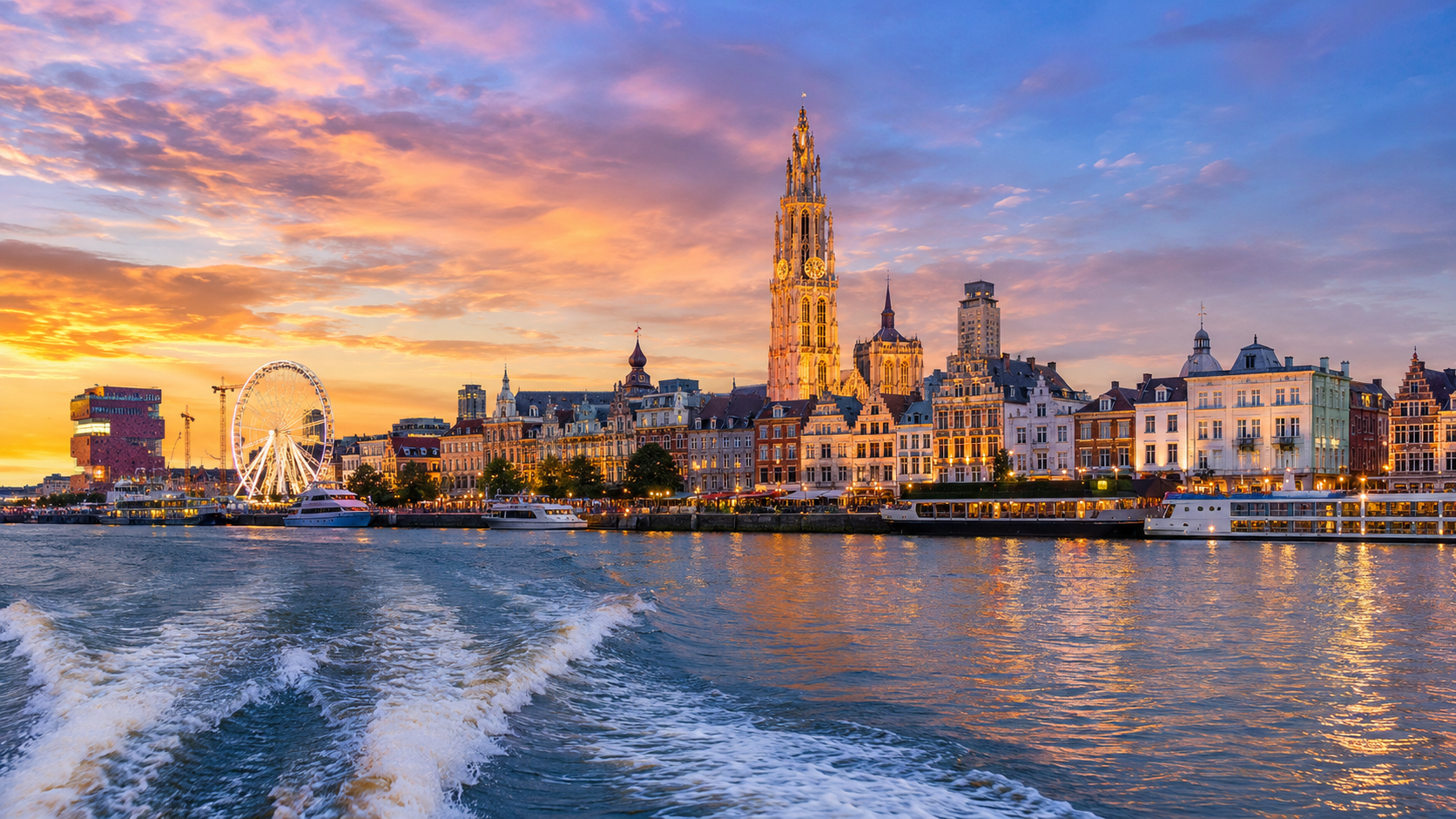
The Scheldt River has shaped Antwerp for centuries. From its surface, the Belgian city unfolds in layers of stone, glass, and reflection. Water offers a vantage point that streets cannot replicate, revealing the rhythms of architecture and port life that define this place as both a medieval center and a modern trade hub. The skyline is dominated by the Cathedral of Our Lady, its soaring 123-meter spire, the tallest church tower in the Low Countries. The Gothic cathedral watches over river traffic just as it has for generations. Beside it, guild houses line the old quays with their ornate facades, remnants of Antwerp’s 16th-century golden age when merchants from across Europe converged on these banks. From a vessel moving upriver, the city compresses and expands with the current. Het Steen anchors the waterfront scene. Built in the early 13th century, it is the city’s oldest building and once served as a prison and military stronghold. Today, its weathered stones contrast sharply against the contemporary structures that flank the harbor district.
Navigating the Port and Historic Riverfront
The Port of Antwerp is Europe’s second-largest seaport, after that of Rotterdam. Antwerp stands at the upper end of the tidal estuary of the Scheldt. The working port stretches for kilometers along both banks, container cranes punctuating the horizon like industrial sculptures. Cargo ships and barges share the waterway with occasional cruise vessels and sightseeing boats. The Antwerp river cruise route passes through sections where medieval history meets contemporary port infrastructure. Vessels navigate the same waters that carried spices from Asia and textiles from England during the city’s Renaissance peak. The 16th century marked Antwerp’s undisputed “Golden Age.” It grew into the most important harbor in North-West Europe and became the richest city on the continent. The Scheldt was a bustling artery, bringing in spices from Asia via the Portuguese, textiles from England and Germany, wines from across Europe, and goods from the Americas.
Modern river traffic coexists with this heritage. The Scheldt is one of the busiest rivers in Europe. The river and its estuary are internationally important for both sea navigation up to the Port of Antwerp and inland navigation. The perspective from the water reveals how thoroughly the river defines the city’s identity and economic function.
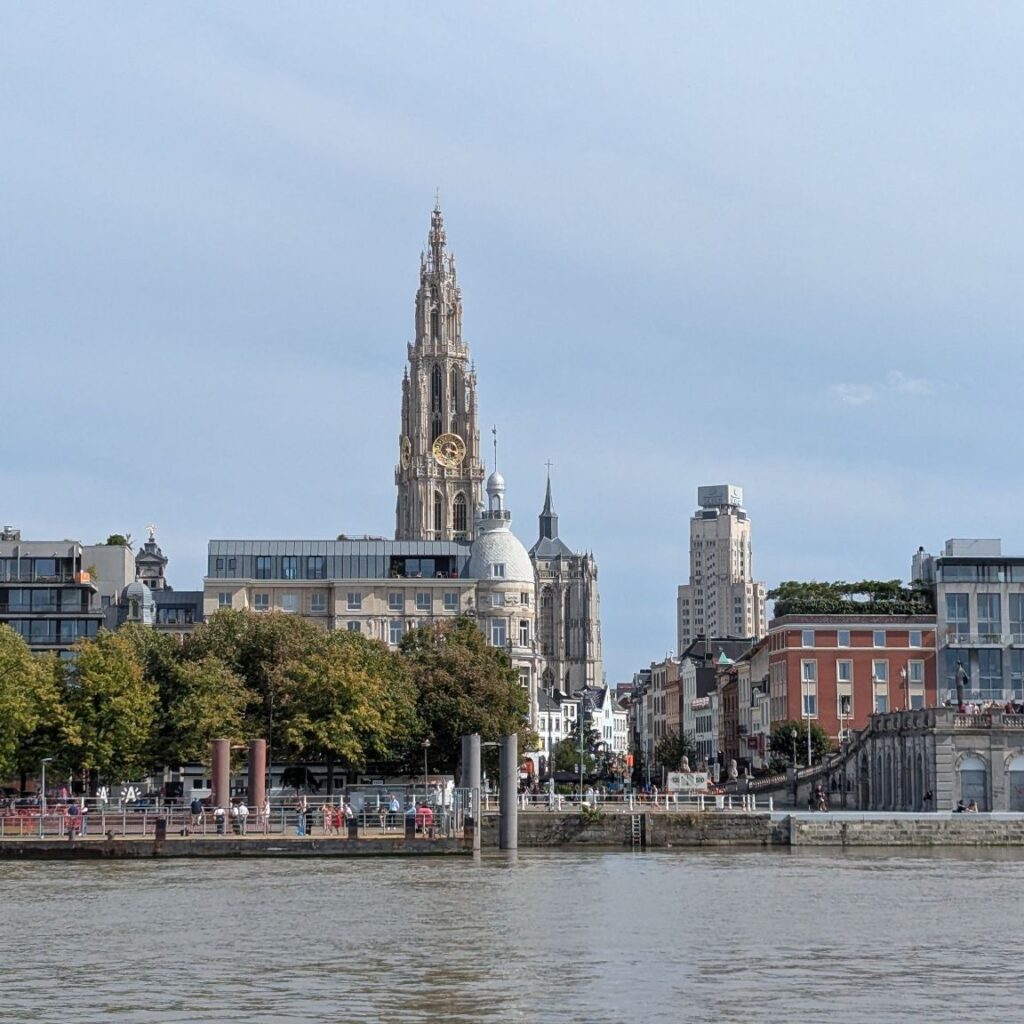
Photo by Willy De Laet: https://www.pexels.com/photo/scenic-view-of-antwerp-city-skyline-and-cathedral-34855097/
Architectural Landmarks Along the Scheldt
The Museum aan de Stroom rises from the harbor district in stacked layers of red sandstone and glass. Designed by Neutelings Riedijk Architects, the MAS features a stacked structure that symbolizes Antwerp’s layers of heritage. The striking combination of glass and red sandstone creates a contemporary yet timeless aesthetic. This architectural masterpiece harmoniously integrates with the city’s skyline while serving as a visual metaphor for the port city’s dynamic evolution and global connections. From the river, its silhouette marks the transition between old port zones and redeveloped waterfront neighborhoods. Further along the Eilandje district, the Port House commands attention with its diamond-faceted glass extension hovering above a renovated fire station.
Formed from a multifaceted glass façade, the new structure reflects and refracts light across the port, mimicking the rippling surface of the nearby River Scheldt. Inspired by both Antwerp’s long-standing relationship with water and its famous diamond industry, the extension glitters by day and glows from within by night. The building functions as headquarters for the port authority, but from the water, it reads as a sculpture, its angular form catching sunlight at shifting angles throughout the day.
European inland waterways have long supported both commercial shipping and leisure tourism. Europe’s waterways have a long history of being utilized to transport freight and travellers from one settlement or country to another. Europe’s geography provides an extensive network of natural waterways which, over time, have been connected by numerous canals. The Scheldt remains central to this network, linking Antwerp to broader European trade routes and cultural exchanges.
The Left Bank Perspective
Crossing to Linkeroever offers the most expansive view of Antwerp’s waterfront profile. Linkeroever provides a scenic view of Antwerp’s skyline, with the Scheldt River beach stretching approximately 1.5 kilometers. From this vantage, the cathedral spire, the MAS, and the layered rooflines of the historic center arrange themselves into a panoramic composition framed by river and sky. The view from the left bank clarifies the city’s relationship with water. On the left bank, riverfront parks and lawns offer some of the best panoramas of Antwerp’s skyline, from the cathedral spire to the MAS and other towers. This side of the river feels more open and less urban, with cycling paths and playgrounds. The distance creates perspective, allowing viewers to grasp how thoroughly the Scheldt binds together port operations, historic districts, and residential quarters.
Port cities globally serve as critical infrastructure nodes. Ports in the Le Havre-Hamburg range, including Le Havre, Antwerp, Rotterdam, and Bremen, handle the largest amount of foreign import and export value, as they compete for trade going to and coming from the Central European hinterland. Antwerp’s position within this constellation becomes clear when viewed from the water, where the scale of container terminals and loading docks underscores its role in European trade networks.
The interplay between old and new architecture defines what Antwerp looks like from the river. Stone fortresses stand beside glass towers. Historic quays meet modern terminals. The water reflects both, creating a doubled cityscape that shifts with light and current. For travelers moving along the Scheldt, the city reveals itself not as a fixed image but as a sequence of perspectives, each one layering history onto the present moment, commerce onto culture, motion onto memory.
Follow the rest of the Top Experiences series
- TOP TWENTY THINGS TO DO IN EGYPT
- WHY YOU SHOULD VISIT MALTA
- TOP FUN THINGS TO DO IN HAMPI
- 10 HISTORICAL PLACES TO ROAM ACROSS THE WORLD
- 10 HISTORICAL MARVELS OF ITALY
- 10 BEST SHOWS IN EUROPE YOU MUST SEE
- DUBAI THRILLS: 7 MUST-DO ACTIVITIES
- 10 HISTORICAL MARVELS IN TURKEY TO ENJOY WITH KIDS
- MOST ENCHANTING PALACES IN EUROPE
- IN‑BETWEEN MOMENTS IN ASPEN
RESPONSIBLE TRAVELING-BECAUSE I CARE


