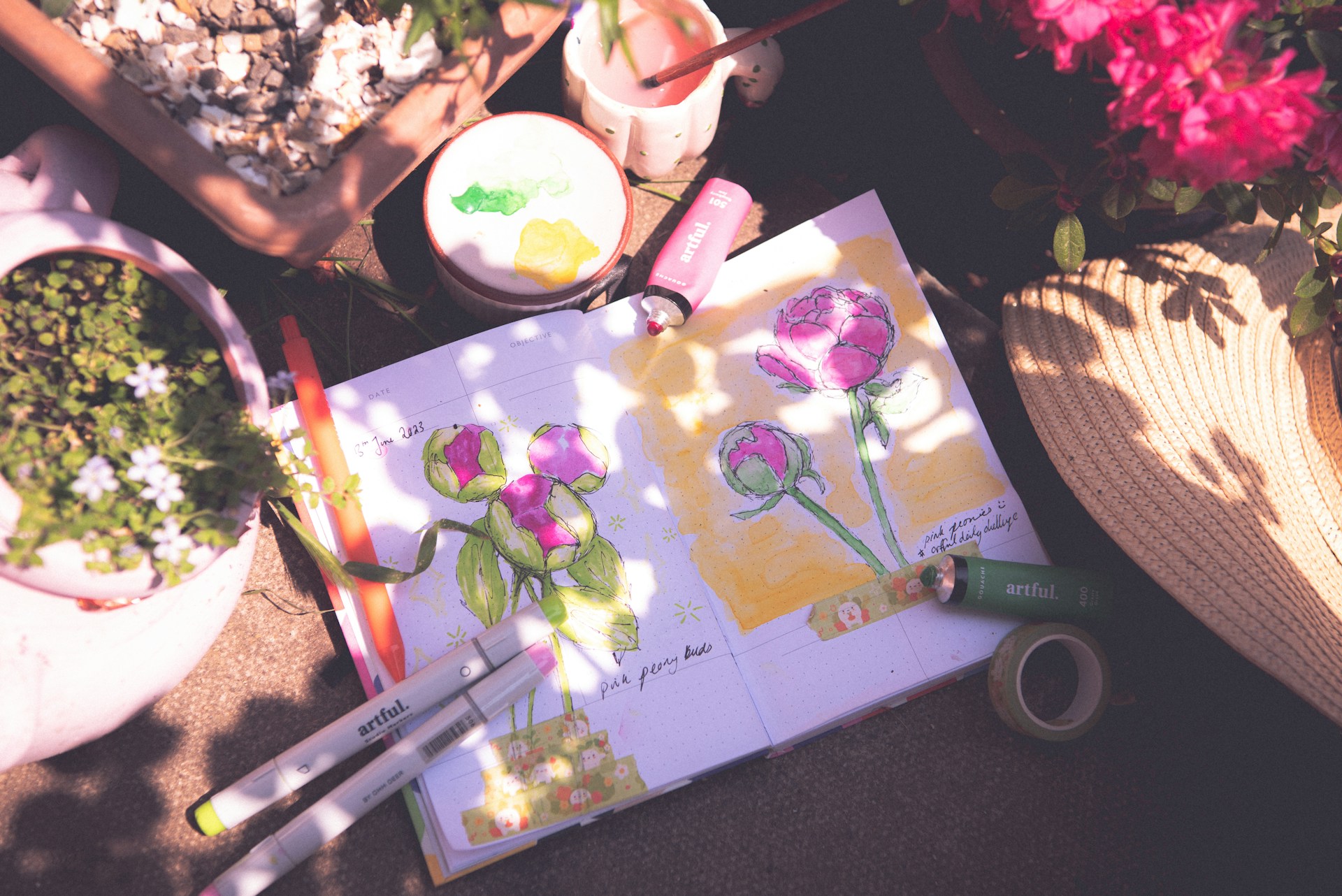
Where Flowers Become Art: A Traveler’s Guide to the World’s Most Painterly Destinations
Every experienced traveler eventually stops buying fridge magnets. At some point, what you want to bring home isn’t a trinket but a feeling – the exact quality of afternoon light over a Provencal field, the smell of cherry blossoms in Kyoto, the deep violet of lavender stretching to the horizon. Flowers do something specific to a place. They change its light, its mood, its color palette. And for centuries, they’ve done the same thing to painters, pulling them off their studio stools and onto the road. This article is for the traveler who wants to go beyond just seeing beautiful flowers. It’s for the destinations where the bond between blooms and art runs deep – whether you’re picking up a brush yourself, visiting a studio, or simply soaking in what inspired the masters.
Why Flowers Have Always Drawn Painters to Specific Places
Flowers have been among the most painted subjects in Western art since at least the Dutch Golden Age of the 17th century. Artists like Jan van Huysum and Jan Davidsz de Heem didn’t just paint flowers they happened to see – they traveled to source them, sketched from botanical collections, and sometimes spent weeks on a single bloom. The flower itself became the destination. That tradition didn’t stop with the Dutch masters. Monet redesigned his entire garden at Giverny specifically to have subjects to paint. Georgia O’Keeffe moved to New Mexico partly because the desert blooms there – jimsonweed, poppies, the cactus flower – were unlike anything she’d found in New York. The place and the painting were always connected.
Today, that connection is stronger than ever. According to Artsy’s 2026 Botanical Art Trends report, modern botanical paintings and floral abstraction are among the most active segments in contemporary art collecting, and demand from collectors is following artists back to the source locations that inspired the work. If you want to understand what’s driving that interest, a good starting point is exploring floral painting as a genre – the range of subjects, styles, and seasonal moods that artists are working with right now. As Botanical Art & Artists notes, there’s a real distinction between decorative flower painting and strict botanical illustration – but both traditions have always sent their practitioners in search of the real thing. You can’t paint a magnolia from memory forever.
Provence, France: Lavender Fields as Living Canvases
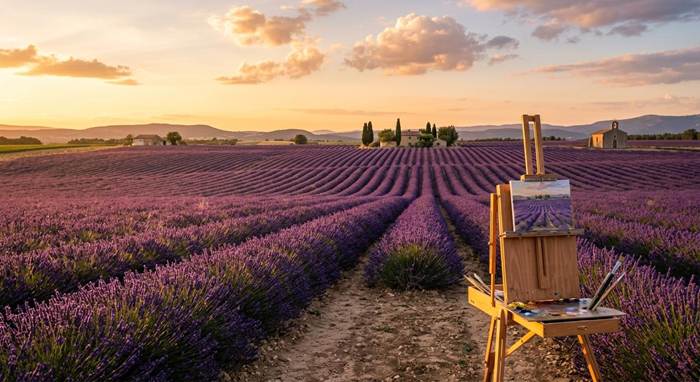
Easel with a painting in a lavender field at sunset, with rows of purple flowers stretching toward distant hills
There’s a reason Van Gogh painted 900 works in 15 months while living in southern France. The light in Provence in late afternoon is unlike almost anywhere else in Europe – warm, directional, and completely unforgiving of bad composition. It shows you exactly what you’re looking at. The lavender fields of the Luberon plateau and the Valensole plain bloom from late June to mid-August. If you plan your trip for early July, you’ll catch them at peak color – rows of deep violet running to the horizon, the smell working on you almost before you register the sight. This is the scenery that’s filled canvases for a century and a half, and it earns the reputation.
A short detour north to Normandy is worth it for Giverny alone. Monet’s Clos Normand garden – the source of the Water Lilies series – is still maintained exactly as he planted it, with climbing roses, wisteria, and the Japanese bridge above the pond. You can stand where he stood. That’s rarer than it sounds. Plain air painting retreats operate across Provence through the summer months. But honestly, you don’t need to paint to make good use of this terrain. Traveling with a painter’s eye – noticing which colors actually repeat, how the shadow reads against the lavender – changes what you see even if nothing ends up on paper. For travelers drawn to European craft culture, the same curiosity that sends you to Provence often leads to artisan traditions elsewhere in the region. The traditions behind handmade Belgian lace make for a natural side trip if you’re moving north through France into Belgium – another place where craft and travel have been inseparable for centuries.
Japan in Spring: Chasing Sakura on Sketchbook Pages
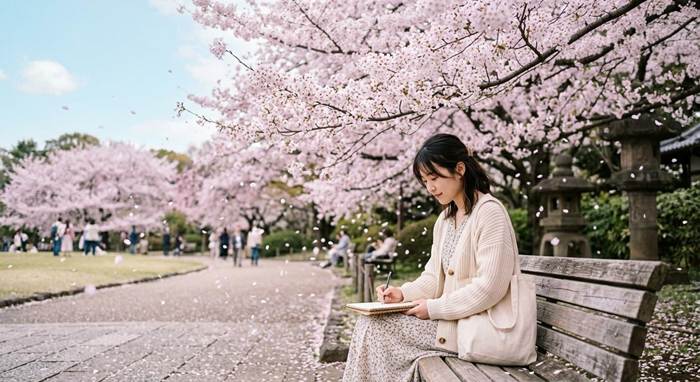
Woman sketching on a bench under blooming cherry blossom trees, with petals falling in a peaceful park setting
Cherry blossom season in Japan runs from late March to early May, shifting north as spring progresses. The window at any single location is roughly ten days. That brevity is half the point. The Japanese concept of mono no aware – loosely, the bittersweet awareness of transience – is built directly into how the culture relates to sakura. The blossoms are beautiful, specifically because they don’t last. This isn’t just a philosophical background. It’s the artistic driver behind centuries of woodblock prints, poems, and paintings that treat the sakura not as scenery but as a statement about time. Ashikaga Flower Park in Tochigi Prefecture takes a different approach – its famous wisteria canopy features specimens over 150 years old, creating a kind of floral architecture you can walk through. The blues, purples, and whites there are unlike standard garden displays. It photographs beautifully, but it paints even better.
Watercolors are the most practical medium for travel painting. They’re compact, they dry quickly, and they don’t fall foul of carry-on liquid restrictions the way oil mediums can. Japan in bloom is arguably the best test case for travel watercolor work anywhere – the subject matter is endlessly varied and the scale shifts from the single branch to the mountainside in a matter of steps. If Asia’s botanical gardens are on your itinerary, it’s worth spending time with the botanical wonders at Singapore’s showpiece gardens – a completely different floral experience, but one that rewards the same attentive eye.
Córdoba, Spain: Where Floral Art Becomes Urban Experience
The Festival Flora in Córdoba, now in its eighth edition as of 2025, does something that most flower festivals don’t. It treats flowers as raw material for large-scale art installations – built from fresh, dried, and organic botanical materials – placed across the city’s streets, courtyards, and historic buildings. According to Thursd’s 2025 coverage of Festival Flora, the festival uses floral art to “activate tourism and position Córdoba as an international reference point” for the intersection of botanical materials and contemporary art. What that looks like in practice is closer to an open-air gallery than a flower show. The installations aren’t decorative. They’re architectural.
Córdoba also hosts the separate Patio Festival – a UNESCO-listed tradition where residents compete to fill their courtyards with geraniums and jasmine in bloom. These aren’t display gardens. They’re working courtyards that get transformed each year by people who’ve been doing this for generations. The design sensibility is entirely its own. Between the two events, Córdoba in May offers something genuinely rare: a city where flowers are treated as both an art medium and a civic tradition. That combination doesn’t happen anywhere else quite the same way.
Bringing It Home: Floral Art as a Travel Souvenir
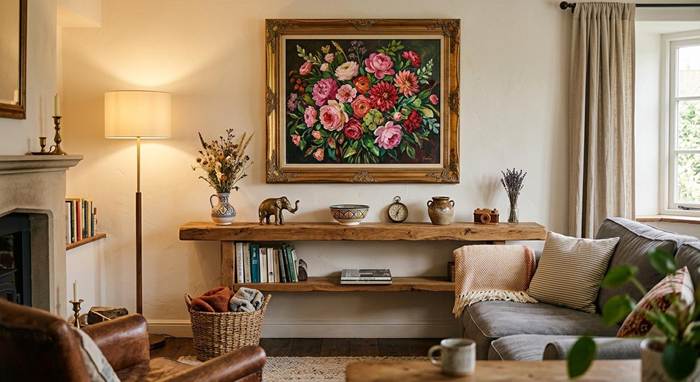
Cozy living room with a floral painting on the wall, wooden shelf decor, soft lighting, and neutral-toned furniture
The souvenir problem for frequent travelers is real. Space is limited, most mass-produced objects look identical across airports, and after a while, things you bought on the road start to feel like clutter. A painting is different. A floral painting holds the specific mood of a place – the exact pink of a Japanese magnolia, the deep violet of Provence lavender, the burnt-orange of a Rajasthani marigold – in a way that stays vivid for decades. It doesn’t need a caption. You know where it’s from. According to Future Market Insights, the global art tourism market was valued at USD 54.7 billion in 2025 and is projected to reach USD 86.5 billion by 2035, driven partly by travelers who now plan trips specifically around artistic and cultural engagement. UNESCO data supports this too – over 40% of international arrivals are now motivated by cultural heritage and artistic experience. People aren’t just visiting places. They’re going to see how those places have been made into art, and to bring some of that back with them.
This pattern shows up in textile and craft traditions as much as in painting. The embroidered motifs that define Gujarat’s artistic identity are a good parallel – the same impulse that pulls a traveler toward a floral painting in a Kyoto gallery pulls them toward a Kutch embroidery in a village workshop. You’re looking for something that captures a place in its own visual language. The Saatchi Gallery’s “Flowers – Flora in Contemporary Art & Culture” exhibition in London in 2025 – which drew enough visitors to be extended and reopened through August – made a related point on a bigger stage. Floral art isn’t a category for decorators. It’s one of the most active areas of contemporary collecting, with a global audience that’s only growing.
The World Blooms for Those Who Know When to Look
The reason these destinations draw artists isn’t just that they’re beautiful. It’s that they’re specific. The right flower in the right light at the right time of year produces something unrepeatable. You don’t get Provencal lavender in October. You don’t get Japanese cherry blossom in summer. The timing is part of the work.
You don’t need to be a painter to travel with this kind of attention. Noticing color, noticing composition, noticing how the light changes the way something reads – these habits cost nothing and change everything about what you bring home from a trip. Whether you come back with a painting you made yourself, one you bought from a local artist, or simply a deeper way of seeing the natural world – that’s a souvenir worth the space in your bag.
Follow the rest of the Top Experiences series
- TOP TWENTY THINGS TO DO IN EGYPT
- WHY YOU SHOULD VISIT MALTA
- TOP FUN THINGS TO DO IN HAMPI
- 10 HISTORICAL PLACES TO ROAM ACROSS THE WORLD
- 10 HISTORICAL MARVELS OF ITALY
- 10 BEST SHOWS IN EUROPE YOU MUST SEE
- DUBAI THRILLS: 7 MUST-DO ACTIVITIES
- 10 HISTORICAL MARVELS IN TURKEY TO ENJOY WITH KIDS
- MOST ENCHANTING PALACES IN EUROPE
RESPONSIBLE TRAVELING-BECAUSE I CARE


