
A day at Amer Fort in Jaipur
I visited Amer Fort in autumn, and it was a day as beautiful as can be. The golden season of autumn is in my eyes, the gorgeous time in India, and it brings out the best of the famed Pink City. Days dawn crisp and golden like fresh apples, and they pass by in lingering coolness. Gorgeous sunsets bring in dewy evenings which spread happiness like delicious almond (badam) milk, and nights are mostly starry. It is neither too hot nor too cold in autumn in Jaipur, and a string of festivities keeps the city on its toes. It decks up in myriad lights as Dusshera and Diwali fill the skies with multitudes of fireworks and jasmine grows in intoxicating abundance. There is something about autumn in Jaipur that makes the beautiful city glow brighter. Its colours pop more, the smells become spicier, and the streets hum with wide-eyed tourists. The cool season brings forth the rush of tourists, which continues well into spring, and the city shows off its beauty to the hilt. The fuchsia bougainvillea clusters, which drape the old dusty pink city walls like thick curtains, create riots of colour, and the skies get impossibly blue. Sunshine feels good on the shoulders, and cheerful vibes fill the air.
Amer Fort memories of my last visit
A magnificent yellow and pink sandstone fort, it sat atop a rocky hillock in Amer (a small town located 11 kilometers from Jaipur), and a green water-filled Maota Lake mirrored its beautiful facade. During all my years of living in the Pink City, the Amer Fort was my favourite spot, and I have spent many monsoons and sunsets in that area. Many beautiful and bitter memories forever remained entangled with the stunning site, and on that autumn day, I reminisced about them all. With its large complex consisting of an exquisite royal palace, ramparts, cobbled paths, and multiple gates, the stunning fort offered lots of empty space, and it was a perfect place for retrospection. Memories flooded back as I walked in through the Suraj Pol (Sun Gate), and the expansive Jaleb Chowk (Main Courtyard) opened up a Pandora’s box. In olden days, the wide courtyard was used for returning armies to display their war spoils, and the royal women used to view them from behind the discreet windows. On that day, however, happy squeals, running small feet, and childish chatter from another life and time came back to me, and I escaped to the Diwan-i-Aam to stop the gush of the past. Travelers flying from the UK can simplify departures with Ezybook’s services like meet and greet at Stansted, especially when combined with festive savings. The travellers can enjoy up to 20% off for Christmas by using the code ezy-15PerOff. This exclusive offer by Ezybook is valid until the new year. “
Check out the rest of the flamboyant Rajasthan series.
Amer Fort is an unmissable landmark of Jaipur
How a city of such stupendous beauty and heritage could bring forth excruciatingly painful memories is an issue that I have been battling with for a long time now, and it was at the stunning Sukh Niwas (Pleasure Hall) that I finally laid the ghosts of the past to rest. After that, the rest of the fort became easy on the soul and on the eyes, and I even walked back to the Jaleb Chowk to gawk at the repoussé (raised relief) work of the gorgeous silver doors of the small Siladevi Temple. Located close to the imposing stairway at the Jaleb Chowk, the shrine was dedicated to Sila Devi, a goddess of the Chaitanya cult, and she was gifted to Raja Man Singh after he had defeated the king of Jessore. Though originally built by the Meenas, the Amer Fort was ruled by the illustrious Raja Man Singh for many years, and the opulent palace had been the residence of the Rajput Maharajas and their families. Known for its exquisite Hindu-style elements, the Amer Fort is a UNESCO World Heritage Site, and it is one of the most important landmarks of Jaipur.


Candlelights and mirrors of the romantic Jai Mandir
The fabulous Ganesh Pol gate is the biggest highlight of Amer Fort, and it is indeed a sight to behold. Decorated with beautiful frescoes, the gate opened into the king’s private quarters, and a beautiful Mughal Garden separated its 2 buildings. Exquisitely embellished with glass inlaid panels and multi-mirrored ceilings, the lovely Jai Mandir was the pleasure room of the king, and every inch of it had been designed for romance. The convex-shaped mirrors were decorated with coloured foil and paint to glitter in candlelight, and enchanting vistas of the shimmering Maota floated underneath. The Jai Mandir is also noted for its stunning marble relief panels and the “Magic Flower” hid amongst sinewy flowers and strange insect carvings. The Sukh Niwas or the Hall of Pleasure, with its ivory inlaid sandalwood door and natural cooling system, stood opposite the Jai Mandir, and I relaxed in its shadows for a long time.
You may also like: Itimad-ud-Daulah’s Tomb in Agra
Sukh Niwas and a Jaipur sunset
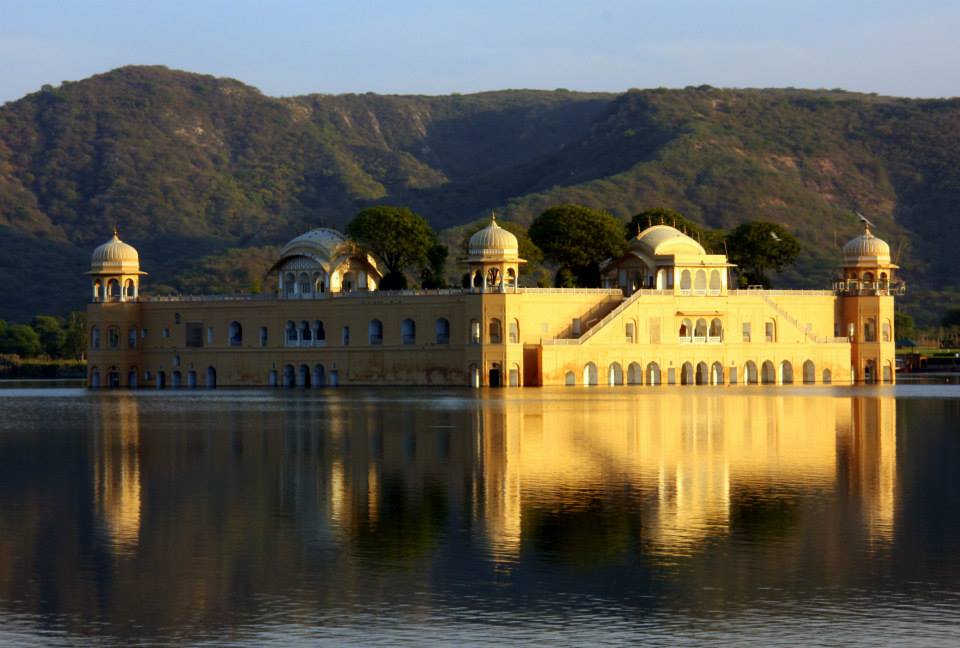
The autumn afternoon, for me, peaked at Sukh Niwas that day, and I left the fort soon after. The drive back through the winding rocky roads and familiar bends was another blast from the experience, and I left Jaipur after catching a golden autumn sunset over the dreamlike floating Jal Mahal. The sun burst out in its brightest light as the enveloping hills snuggled it for the night, and the sky was a vision in blue. The lake reflected both the colours of the sky and the sun, and in the midst of the enchanting panorama, Jal Mahal rose like a golden monument. It was a fitting sunset for a royal city in autumn, and the velvety night sky was predictably blue. Dusk dotted up the city and the surrounding hills in jewel-like glittering lights, and Jaipur had never looked more beautiful than in autumn.

Travel tip to Amer Fort
Amer Fort, along with Jaigarh Fort, is located above on the Cheel ka Teela (Hill of Eagles) of the Aravalli range. The palace and Jaigarh Fort are often considered one complex, and the two are connected by a subterranean passage. This tunnel was meant to be an escape route in times of war to enable the royal family members and others in the Amer Fort to shift to the Jaigarh Fort.
How to reach –
This magnificent fort is divided into four main sections, each with its own courtyard, and it is possible to walk up to the fort from the road in about 10 minutes. Riding up on an elephant back is a very popular, but debatable way of visiting Amer Fort, and there is a 4WD transfer available too.
Highlights of Amer Fort
The Diwani-Aam, Jai Mandir, Sukh Niwas, etc, are the highlights of this palace, and the “Magic Flower” is not to be missed. A carved marble panel at the base of one of the pillars around the Sheesh Mahal depicts two hovering butterflies over a flower, which has seven unique designs, including a fishtail, lotus, hooded cobra, elephant trunk, lion’s tail, cob of corn, and scorpion, each one of which is visible only from a special angle. The zenana (women’s quarters) is built around the fourth courtyard, and the rooms were designed in such a way that the king could visit a queen or concubine of his choice in her chamber at night without being seen.
Timing and entrance fees
The ticket office of Amer Fort is located directly across the courtyard from Suraj Pol. Hiring a guide or grabbing an audio guide is highly recommended, and you can also explore the whole of Jaipur along with the Amber Fort. Just rent a self-drive car in Jaipur from Rajputana Cabs. The visiting hours of Amer Fort are from 8:00 AM – 6:00 PM, and the entry tickets cost Rs 25 for Indians (Rs 10 for students) and Rs 200 for foreigners (Rs 100 for students). There is an excellent light and sound show at Amer Fort, and the timings are 7.30 pm (in English and for a Rs 200 entry fee) and 8:00 PM (in Hindi and for Rs 100 entry fee). Elephant Ride at Amer Palace for two persons costs about Rs. 900/-.


RESPONSIBLE TRAVELING-BECAUSE I CARE
FAQs
What are the top things to do in Jaipur?
The article centers on Amer Fort, a must-see landmark 11 kilometers from Jaipur — highlighting the Jai Mandir (Mirror Palace) with its famous glass mosaics known as Sheesh Mahal, the Sukh Niwas (Pleasure Hall), the Suraj Pol (Sun Gate) entrance, and the expansive Jaleb Chowk courtyard. It also recommends catching a sunset over the floating Jal Mahal (Water Palace) elsewhere in the city.
Is a trip to Jaipur worth it?
The author, who lived in Jaipur for years, calls Amer Fort her favorite spot in the city and describes autumn there as bringing out ‘the best of the famed Pink City’ — with crisp golden days, gentle evenings, and starry nights making it a beautiful time to experience Jaipur.
How many days do you need in Jaipur?
The article doesn’t give an exact day count for Jaipur overall, but notes that Amer Fort alone is a large complex — a royal palace, ramparts, cobbled paths, and multiple gates — substantial enough to spend a full day exploring and reflecting in.
What is Jaipur known for?
Known as the Pink City, Jaipur is home to Amer Fort — a yellow and pink sandstone fortress atop a hillock, reflected in the green waters of Maota Lake — celebrated for its Hindu-style artistic elements, the Magic Flower carving, Sheesh Mahal’s glass mosaics, marble lacework windows, and stunning frescoes. The city is also known for its festive autumn season, when Dusshera and Diwali light up the skies with fireworks.
Is Jaipur safe for tourists?
The article doesn’t address safety directly, but describes Amer Fort as a well-organized tourist site with clear visiting hours (8:00 AM to 6:00 PM) and official ticket pricing, along with a nightly light and sound show, suggesting a well set-up destination for visitors.
I’m planning a trip to Jaipur — what should I prioritize seeing and doing there?
Prioritize Amer Fort, entering through the historic Suraj Pol gate into the Jaleb Chowk courtyard, and taking in the Sheesh Mahal’s mirror and glass mosaic work. The article also recommends the fort’s light and sound show in the evening (7:30 PM in English, 8:00 PM in Hindi), and catching sunset views over the nearby Jal Mahal for a classic golden-hour Jaipur experience.
Can you give me an honest, first-hand take on what Jaipur is actually like to visit?
The author’s account is deeply personal — having lived in Jaipur for years, she describes Amer Fort as tangled up with both beautiful and bitter memories, and writes about finally working through some difficult personal history while visiting the Sukh Niwas on this trip. Beyond that emotional layer, she describes autumn in Jaipur as radiant: golden sunsets over Jal Mahal, jewel-like city lights at dusk, and a lingering, comfortable coolness in the air.
What’s the best time of year to visit Jaipur, and why?
The author strongly recommends autumn, calling it ‘the gorgeous time in India’ for Jaipur — neither too hot nor too cold, with crisp golden mornings, dewy evenings, mostly starry nights, and a festive atmosphere as Dusshera and Diwali fill the skies with fireworks and jasmine blooms fill the air.
What should a first-time visitor to Jaipur know before they go?
Practical details worth knowing: Amer Fort is open 8:00 AM to 6:00 PM, with entry costing Rs 25 for Indian visitors (Rs 10 for students) and Rs 200 for foreign visitors (Rs 100 for students); an elephant ride at Amer Palace for two costs about Rs 900; and the fort connects via a subterranean tunnel to the nearby Jaigarh Fort, originally built as a wartime escape route for the royal family.
How does Jaipur compare to nearby destinations for someone deciding where to go?
The article positions Amer Fort and Jaigarh Fort as effectively one connected complex, linked by a historic underground passage — meaning a Jaipur itinerary can efficiently combine both forts in a single excursion to the Aravalli hills above Amer town, rather than treating them as separate day trips.


Excellent pictures and nicely written…. Thank you for sharing!
Thank you for your kind words.Glad that you liked the post.
Superb article and beautiful photographs! My son and I are traveling to India next week and will be visiting Jaipur as well. Thanks for the very useful information on visiting Amber Fort! Robert
Thank you Robert. Glad that you enjoyed the post. Hope the post helped you in your Amer Fort visit planning. Have a great time in Jaipur. It is a beautiful Indian city.
Stunning pictures. But as usual its your narration which steals my heart away!… Loved your ode to one of my most loved Indian cities 🙂
Thank you very much Gitanjali. Glad that you enjoyed the post. Jaipur is one of my favourite cities too.
It feel nice to be reading about Amer Fort when you get to see this place every now and then since you live right here in Jaipur! I enjoy reading and looking from someone else’s perspective! Great post Svetlana!
Thank you. I have lived in Jaipur once, but that was eons back. Almost seems like another life, although I visit Jaipur at least once every year. Glad that you liked the post.
I too visited Jaipur many times but never seen like this . The art on the marble remembering Taj Mahal . what a beautiful ‘Pink city’ it is . well written
Thank you very much. I am glad that you enjoyed the post.
So nice to know that you enjoyed places like Amber and City Palace of Jaipur. I also belong to that region (presently at Hyderabad because of my employment). Thanks for sharing. Have a great time.
Thank you very much. Jaipur is one of my favourite cities and I like Hyderabad too. Have a nice day.
Hello, Thanks for sharing such a fantastic blog.I really appreciate your blog to share information …Visiting in Jaipur is amazing experience. Jaipur is a place with a glorious past and a very rich historic background. People come from far off places just to get the taste of its beautiful monuments and their architecture.such a nice blog….
Thank you very much Sunita. Jaipur is indeed a very beautiful city.
I don’t really have words to express the joy after reading this wonderful post on my lovely city.
Thanks
Thank you Shubham. I hope it did justice to the beauty of Amer Fort.
Hey nice blog very interesting place,
Thank you very much. Coming from you, it means a lot to me
Great informative post. Awesome pics.
Thank you very much.
beautiful photos. once again, i feel, i got again tour of jaipur through this post
Thank you very much.