
Road trip through Upper Egypt: Aswan to Luxor
The most popular way to travel between Aswan and Luxor is by Nile Cruise. Alternatively, Upper Egypt can be explored by train and a very enjoyable road trip. This option also lets you add three important sites of Kom Ombo, Edfu and Esna. The drive is a straightforward one and it takes a few hours. However, with stops, it can be a full day of sightseeing of many amazing temples.
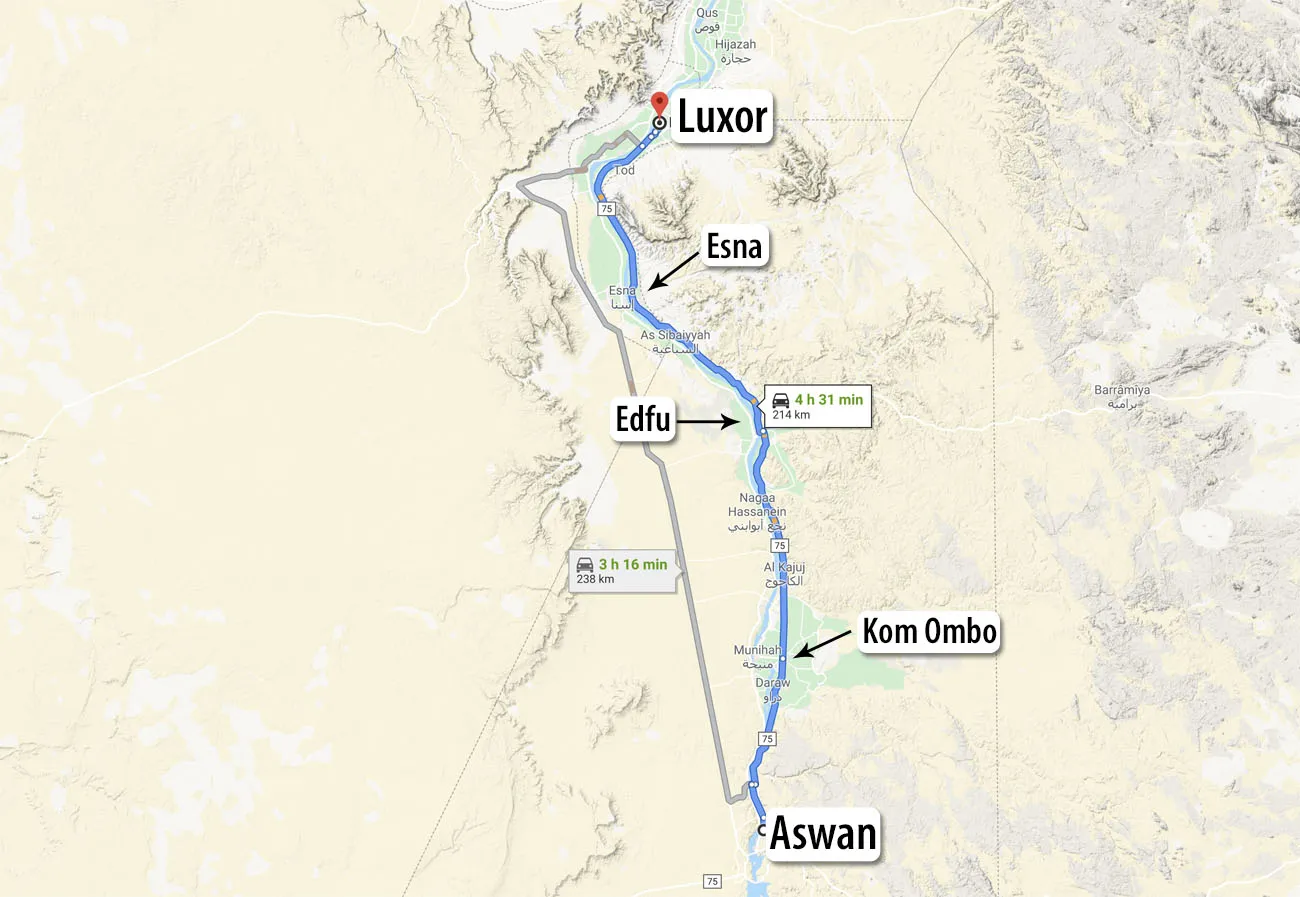
Details of the Upper Egypt road trip
Length of Time: 9.5 hours including visiting the three temples
Driving Distance: 245 km, roughly 5.75 hours of driving
The highway between Aswan and Luxor is just a three hours drive of straight driving without stopping. The drive along the picturesque rural roads on the east bank of the Nile river takes approximately four and a half hours. We started our drive from Aswan at around 10 am and reached Luxor after visiting the three temples at around 5 pm. It can be done in the reverse direction as well i.e from Luxor to Aswan.
Cost: When we did this road trip, hiring a minivan with a driver cost us 2000 EGP with gas. This did not include the parking tickets.

The crocodile temple of Kom Ombo
Driving Distance and Time (Aswan to Kom Ombo): 47 km, 1 hour from Aswan.
The Temple of Kom Ombo in Upper Egypt is a double temple that is dedicated to two gods, Sobek, the crocodile-headed god and Horus, the falcon-headed god. Next to the Temple of Kom Ombo is the Crocodile Museum, which houses mummies of different sized crocodiles that were discovered around the temple.
- Entrance Ticket Cost: 140 EGP adult; 70 EGP student with valid ID
- Camera Ticket: Photography is permitted and free.
- Crocodile Museum: Photos with a cellphone are free. The crocodile museum has camera charges.
- Timings: 6 am to 9 pm


The temple of Horus at Edfu
Driving Distance and Time (Kom Ombo to Edfu): 70 km, 1.75 hours
The Temple of Horus is the largest temple dedicated to the god Horus. It is one of the best-preserved temples of Upper Egypt.
- Entrance Ticket Cost: 180 EGP adult; 90 EGP student with valid ID
- Camera Ticket: Photography is free and permitted.
- Timings: 6 am to 5 pm.

The Temple of Khnum in Esna

The Greco-Roman Temple of Khnum at Esna
Driving Distance and Time (Edfu to Esna): 64 km, 1.5 hours
The temple in Esna is dedicated to the god Khnum, a ram-headed god who fashioned humanity on his potter’s wheel. It was much patronized by the Ptolemies and the Roman rulers of Egypt.
- Entrance Ticket Cost: 80 EGP adult; 40 EGP student. The ticket booth is located on the Nile River, near where the cruise ships dock. From here, it is a short walk through the local market to get to the temple.
- Camera Ticket: Photography is free and permitted.
- Timings: 6 am to 9 pm
To drive from Esna to Luxor, it is a 64 km drive that takes 1.5 hours.

Upper Egypt road trip practicalities
There is also the option to take the train and in each town, one has to hire a taxi or a tuk tuk to get to and from the train station. The drive itself is very enjoyable and picturesque. It gets lovelier as you drive through the rural roads on the East Bank of the Nile. This is the sugarcane country and near the river, the land is rich and lush with bananas, mangoes, lemons, tangerines, and other agricultural plants. You can also see patches of the famous Egyptian cotton plantations. Traffic consists of donkey drivers, donkey carts, tuk tuks, a few buses, trucks, tractors, and vans. Driving is pretty mad especially if you come from a country where traffic rules are followed. The road condition is mostly good. Make sure to carry lunch boxes from the starting city. There are not many good quality restaurants or cafes on the way. Clean restrooms are also difficult to find.


Follow the rest of the Egypt series here
- A CLASSICAL EGYPT ITINERARY
- SLOW TRAVELING IN ASWAN
- BLUE GOLD COLOURS OF THE PHILAE TEMPLE IN ASWAN
- ASWAN GUIDE
- ASWAN SOUQ PHOTO TOUR
- KOM OMBO TEMPLE: THE CROCODILE TEMPLE OF EGYPT
- NILE CRUISE GUIDE AND EXPERIENCE
- AN EDFU MORNING
- THE LUXURY OF LUXOR
- KARNAK AND LUXOR, THE BEST OF THE LUXOR TEMPLES
- LUXOR WEST BANK ATTRACTIONS IN A NUTSHELL
- TOMB OF NEFERTARI
- THE BEAUTIFUL TEMPLE OF KHNUM AT ESNA
RESPONSIBLE TRAVELING-BECAUSE I CARE
FAQs
What are the top things to do in Aswan?
This particular article covers the road trip out of Aswan toward Luxor rather than Aswan’s own sights specifically — but it highlights the three key temple stops along the way: Kom Ombo, Edfu, and Esna (dedicated to the ram-headed god Khnum, who was believed to have fashioned humanity on his potter’s wheel), all reachable as a full day’s drive from Aswan.
Is a trip to Aswan worth it?
The article frames the Aswan-to-Luxor road trip as a genuinely enjoyable alternative to the popular Nile Cruise route, describing the drive along the East Bank as increasingly picturesque through rich, lush sugarcane country as you travel through Upper Egypt.
How many days do you need in Aswan?
For this specific road trip between Aswan and Luxor, the article estimates about 9.5 hours total including visits to all three temples (Kom Ombo, Edfu, and Esna), based on a driving distance of 245 km and roughly 5.75 hours of actual driving — doable as a full single day of sightseeing.
What is Aswan known for?
As the starting point of this classic Upper Egypt route, Aswan is the launching point for reaching three significant ancient temples on the way to Luxor, with the most popular travel method being the Nile Cruise, though the article highlights road tripping and rail as enjoyable alternatives.
Is Aswan tourist-friendly?
The article suggests the road trip route is well set up for independent travelers — entrance fees are clearly listed (Esna’s temple costs 80 EGP for adults, 40 EGP for students, with free photography), and taking the train is also an option, requiring a taxi or tuk-tuk to reach each town’s train station.
I’m planning a trip to Aswan — what should I prioritize seeing and doing there?
If road-tripping from Aswan to Luxor, prioritize stops at Kom Ombo, Edfu, and Esna’s Temple of Khnum along the way — the Esna temple ticket booth is near the Nile cruise dock, with a short walk through the local market to reach the temple itself, open daily from 6 am to 9 pm.
Can you give me an honest, first-hand take on what Aswan is actually like to visit?
The article speaks enthusiastically about the drive itself as part of the Aswan experience — describing the East Bank route as very enjoyable and picturesque, growing lovelier as it passes through rural sugarcane country along the Nile, with the land near the river notably rich and lush.
What’s the best time of year to visit Aswan, and why?
The article doesn’t specify a best season for the road trip or Aswan generally.
What should a first-time visitor to Aswan know before they go?
First-time visitors planning this route should know the direct highway drive between Aswan and Luxor takes only about three hours without stops, but a full day should be budgeted if visiting all three temple stops. Taking the train instead means arranging a taxi or tuk-tuk at each stop to reach the town center and temple.
How does Aswan compare to nearby destinations for someone deciding where to go?
The article positions Aswan as the natural starting point for a broader Upper Egypt exploration, with the alternative road-trip or train route to Luxor offering more flexibility and additional stops (Kom Ombo, Edfu, Esna) compared to the more fixed, popular Nile Cruise itinerary.


