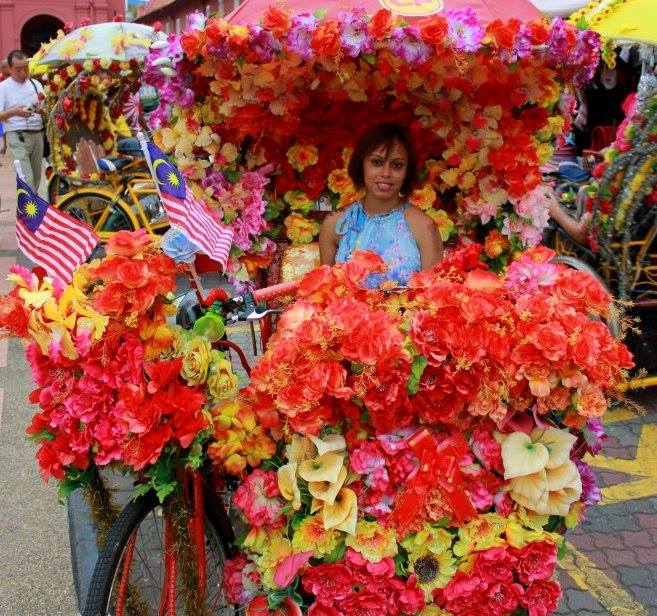
Letters from Melaka
Greetings from the warm Malacca Straits. I am in the rose-red, beautifully preserved city of Melaka, and it just feels great here. This is the heart of the elusive, but dazzling Baba Nyonya culture, and Perankan liveliness has never been more vivid. It’s been a warm, sunny day, and I have come to Melaka from Kuala Lumpur for some R&R. KL can be an exhausting metropolis, and work is difficult in Malaysia’s muggy heat. This is my umpteenth trip to Melaka, and I never fail to visit this lovely erstwhile Portuguese and Dutch colony whenever in the Malaysian mainland. So, what draws me here endlessly like magic, you may ask? And the answer is endearingly simple. Melaka is sweet, if ever that adjective can be applied to a city, and it is the best place to let your hair down (at least in my eyes).
Melaka, a UNESCO World Heritage
The name sounds mellifluous, rolling off the tongue easily. Its UNESCO World Heritage City Center is a touristy delight, and the Melaka River is soft and lazy. The city is well-maintained, offers great shopping, and the food is to die for. All these attributes make Melaka the perfect getaway spot, and then there’s the enticingly layered, elusive history. Melaka has a daredevil, vigorous history which belies its present-day laid-back charm, and the city has centuries of bloody rifts behind it. In fact, its birth is shrouded in legends, which heightens Melaka’s allure, and the port city, which had been catapulted to prosperity by its reigning Sultans, originated from a sleepy fishing hamlet. Inhabited by local Orang Laut Malays, Melaka had been discovered by Parameswara, the last Rajah of Singapore (the then Tamasek) in the 1400s.

How Melaka came into being
By then, the Javanese and Thai kings of Ayuthaya had already realized the trading potential of the Malay Strait, and furious rifts had ensued between the two. Parameswara, himself, had been a victim of those fierce struggles of domination, and he had allegedly been a Sumatran prince before fleeing to found the new establishment of Tamasek or Singapore. The Javanese, however, had not left him in peace, and they had eventually forced him to take refuge at a place north of Bertam. The simple local people had welcomed the exiled royal, and he had settled his family there too. One day, when his son, Prince Iskandar Shah, had gone hunting near the modern-day Melaka Hill, a fleeing mouse deer had led him to the sea. Iskandar had the immediate sense to foresee the spot’s trading potential and had asked his father to seize the opportunity. The old ex-rajah had faithfully worked on the good omen and had established a brand new settlement there. Iskandar had named it Melaka after a tree under which he had been sitting on that fortunate day, and the rest they say is stuff legends are made of.

The unique culture of Melaka
Melaka flourished from its very conception, and the ruling sultans soon turned it into an international port. With cooperation from the local sea-faring Orang Lauts and scattered pockets of individual Malay maritime merchants, they built safe and reliable warehouses, facilities, and firmly established fair trade. Soon, a wealthy and cosmopolitan town sprang up around the port, and it became a major trading hub of textiles and spices between Indonesia and India. Wealth brought ambition to Melaka’s rulers, and its territorial expansion eventually spread as far as Perak, Singapore, and parts of Sumatra. Culture flourished too, and soon the merchant town became a hotbed of fine language, dance, literature, and formal royal court etiquette. Melaka became a queen, and her fame spread far and wide. The smell of money by then lured the Chinese traders and expeditionaries, and soon formal relations ensued. The Chinese royals and traders intermarried with the locals of their social strata, adapted to the Southeast Asian practices and languages, and this gave rise to the bedazzling Perankan culture.

The interesting Perankan culture
Perankan loosely denotes a gorgeous melting pot of ethnic identities, and today this word refers to many socio-cultural groups in Singapore, Indonesia, and Malaysia. Although they have branched into Perankan Dutch, Perankan Chitty, Perankan Jawi, etc, Melaka remains the birthplace of this unique culture. That’s why the city is a treasure house of Baba Nyonya origins, and many beautiful museums display its glories. Baba is an honorary title given to a Perankan man of means, and his Chinese ancestry as well as local residence in the Malay straits go back centuries. Nyonya is Baba’s female equivalent, and this invaluable title is not handed out to Chinese immigrants of recent times. Vintage Baba Nyonya photos show exquisite people dressed in formal garbs, and they are a gorgeous mix of ornate Chinese styles with Southeast Asian vibrancy. Their cuisine, too, is ravishingly delicious, and it was the blend of both that first attracted me to Melaka.


Oppulence and intricate
Everything about the Peranakans had spelled money, and the ostentatiousness of their costumes, along with their love for gold and handmade slippers intricately embroidered with Peranakan cut beads, complemented perfectly with the traditional dinnerware they had used. Their life was dedicated to fine luxurious details, and their eye for intricacy was visible in every aspect of Peranakan culture. Victorian era crystal chandeliers, dazzling gilt trimmings, rich costumes, beaded slippers, and exquisite jewelry showed off the “on your face” indulgent life of these rich traders, and I found their Peranakan tiles to be most exquisite. Found generously plastered on old buildings, passages, floors, and door sills, the Peranakan tiles are unique to the mysterious Baba Nyonya culture, and I came across them in several Southeast Asian cities like Singapore, Georgetown, etc. Because of the humid weather, in olden times all Peranakan houses opted for a uniform flooring of the unique tiles, and eventually, their colourful prettiness, apart from the cooling factor, made them popular as home decor items too. Lilies, roses, and carnations of pinks, pistachio greens, and baby blues were the most popular motifs for the walls, and the floors were resplendent with geometric designs in mostly white, black, yellow, and sapphire.
Baba Nyonya area of Melaka
I love the Peranakan tiles’ childlike, simple loveliness, and they were a burst of beauty, making even the drab areas of a building come alive. The preserved Baba Nyonya area of Melaka, too, was like an open-air gallery of these tiles, and on that hot afternoon, I happily spent hours tracing my fingers over their cool, uneven surfaces. Despite the heat and general feeling of unease, that afternoon was one of the most pleasant days of my life, and it was very picturesque too. A bright midday sun kept the crowds at bay, thus providing the heritage place nearly for myself, and pieces of an exquisite blue sky showed from between bright old buildings. Except for occasional stray cats and smokers, hardly anybody was visible, and the siesta time had contributed to a quiet, cozy lull. It was a peaceful, solitary walk.


An afternoon walk in Melaka
Everywhere, rainbow colours of lemon yellow, aqua blue, dusty rose, ruby reds, and orange glided past me in forms of old restored Peranakan homes, and strings of Chinese lanterns fluttered over beautiful street art splattered walls. At times, I felt as if I were walking through a virtual garden, and the patterned beauty of pavements, walls, and window sills decorated prettily with floral tiles, miniature dragons, and rosy lintels, was bedazzling. Flowers peeped from every nook and corner, and concrete roses twined around floral bouquets under salmon coloured roofs. Resplendent in this exotic beauty, Melaka never seemed more beautiful, and the abundance of gorgeous Peranakan tiles threw delicate floral hues at every step. The stately old buildings, fluttering lanterns, and springing flowers whispered tales of old glory, and it was the sudden livening up of the scene that had brought me back to reality. Being a weekend, a soft Melaka sunset started making the flea market at Jonker Street buzz with action, and lost in my walk, I never noticed the time slipping by.
While on any other day, the prospect of a flea market would have excited me like crazy, on that evening, I was happy to give it a miss. Instead, I sat at an outdoor table of the Geographer’s Cafe and recollected details of my exquisite Melaka afternoon. It was a walk to remember, and I left Melaka with beautiful memories to last a lifetime.


Follow the rest of the Malaysia series
- KUALA LUMPUR PHOTO ESSAY
- FOOD TOUR IN KUALA LUMPUR
- CHARMING GEORGETOWN
- GEORGETOWN PENANG STREET ART
- GEORGETOWN PENANG STEEL SCULPTURES
- PULAU LANG TENGAH
RESPONSIBLE TRAVELING-BECAUSE I CARE
FAQs
What are the top things to do in Melaka?
The article centers on immersing yourself in Melaka’s Peranakan (Baba Nyonya) culture — exploring the opulent, gilded Baba Nyonya heritage area with its Victorian-era chandeliers, ornate costumes, beaded slippers, and distinctive tiled buildings, and taking an afternoon walk through the rose-red, well-preserved streets of this former Portuguese and Dutch colony.
Is a trip to Melaka worth it?
Very much so, according to the author, who describes this as their ‘umpteenth’ trip and says they never fail to return whenever they’re on the Malaysian mainland. They call Melaka ‘sweet’ and describe it as drawing them back ‘like magic’ every time.
How many days do you need in Melaka?
The article doesn’t specify a set number of days — the author frames their visit as a relaxed R&R escape from the more exhausting pace of Kuala Lumpur, suggesting Melaka works well as a short, unhurried getaway rather than a rushed stop.
What is Melaka known for?
Melaka is a UNESCO World Heritage city known for its rose-red, beautifully preserved colonial architecture (a legacy of Portuguese and Dutch rule) and for being the historic heart of Peranakan, or Baba Nyonya, culture — a striking blend of ornate Chinese styles with Southeast Asian vibrancy, seen in its cuisine, costumes, jewelry, and richly decorated tiles.
Is Melaka safe for tourists?
The article doesn’t address safety directly, but it describes Melaka as a warm, welcoming city that the author has returned to countless times for relaxation, suggesting a comfortable, low-stress destination compared to the intensity of nearby Kuala Lumpur.
I’m planning a trip to Melaka — what should I prioritize seeing and doing there?
Prioritize the Baba Nyonya heritage sites — the article highlights the opulence of Peranakan culture, from Victorian-era crystal chandeliers and rich costumes to the intricately embroidered beaded slippers and ornamental Peranakan tiles found on old buildings, passages, and floors throughout the city. An unhurried afternoon walk through Melaka’s historic streets is also recommended.
Can you give me an honest, first-hand take on what Melaka is actually like to visit?
The author writes with clear affection, describing an escape from Kuala Lumpur’s exhausting, muggy pace to a city that ‘just feels great.’ They call Melaka sweet and describe being endlessly, almost magically drawn back to it — driven largely by the city’s rich Peranakan heritage and its blend of history, culture, and food.
What’s the best time of year to visit Melaka, and why?
The article doesn’t specify a best season, though the author’s own visit took place on a warm, sunny day, and Melaka’s tropical Malaysian climate is described as generally warm year-round.
What should a first-time visitor to Melaka know before they go?
First-time visitors should know Melaka’s founding legend adds real depth to a visit: the city, according to local lore, was named by Prince Iskandar Shah after a tree he sat under near modern-day Melaka Hill, after a fleeing mouse deer led him to a spot he recognized for its trading potential. Knowing this story — and the Portuguese and Dutch colonial history that followed — helps make sense of the city’s uniquely layered architecture and culture.
How does Melaka compare to nearby destinations for someone deciding where to go?
The article draws a direct contrast with Kuala Lumpur, describing KL as an exhausting metropolis where work is difficult in Malaysia’s muggy heat, while Melaka is framed as the restorative counterpoint — a place the author specifically travels to from KL for rest and relaxation.


Awesome photos. Thanks for the post 🙂
Thank you. Glad that you liked the post Rupam.
such amazing style. beautiful buildings. thanks for sharing!
Thank you very much for your kind words Andrew. Melaka was drop dead photogenic.
Cheers. (Was that a Corona on your table?) 😉
Thank you for the trip.
Brian
You are welcome. That Corona was just soooo nice after my long walk.