
Dance like a man II
Gotipua had been a treat for my cultural senses. Rhythmic, seriously acrobatic and exotic in a most quintessential Indian way, the literal translation of Gotipua means, “single boy”. The dance form has been performed in Odisha by groups of young boys for centuries, when they would dress up like females to praise Lord Jagannath and Krishna. Gotipua dance is not easy to master and boys start training at a very early age until adolescence, when their smooth androgynous looks start getting rugged. Rigorous training and regular practice are part and parcel of Gotipua curriculum and the boys stay at their teacher’s gurukul (school) under his tutelage. It is he, who decides on their formal education as well as dance lessons and to seamlessly blend into their onstage feminine looks, Gotipua students do not cut their hair, apply make up and wear effeminate costumes.
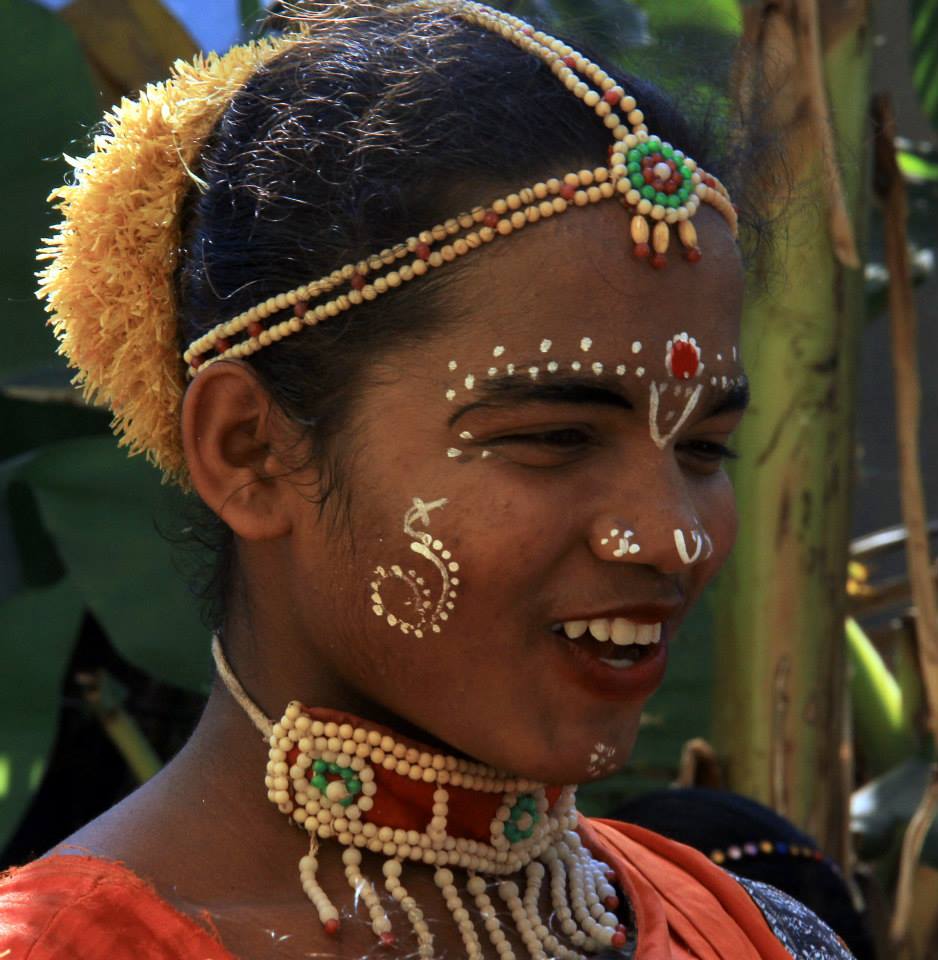
Gotipua dancers weave floral garlands into their hair and their make up adheres to the dramatic style followed in quintessential Indian classical dances. Kohl or kajal are lined thickly and traditional sandalwood patterns adorn the faces. The costume too is as gorgeous as the dance and worn in usual bright colours, intricate beaded jewelry complete the look. Although, the old practice of nose piercing has been replaced by painted motifs among Gotipua dancers, boys still line their feet with traditional red alta and wear stringed bells called ghungurs, to accentuate the dance steps. I had found the bunch of gorgeously dressed made up giggling boys to be very cute and the Odisha rural afternoon had passed like a dream to the beat of their tapping footsteps. The sun had filtered in through the old rustic windows as strains of religious songs and jingling ghungurs had rung through the air, and the domesticated hens had crowed loudly in fierce competition. Neighbours had peeped unabashedly from everywhere, spilling through doorways, windows and towering over shorter audience and at times, I had wondered, if the curiosity had stemmed because to the dancers or me.
There had been no doubt that Gotipua is a dying art and while it’s contemporary Odissi has a whole Konark Dance Festival dedicated to it, there are hardly any takers for this exquisite dance form. To technically consider Odissi as a contemporary of Gotipua would be twisting of historical facts and truth be told, Gotipua had pre existed before Odissi. The modern Odissi dance has been greatly inspired by Gotipua and most great Odissi exponents like Guru Kelucharan Mahapatra had been Gotipua dancers in their youth. Evolution of Gotipua had been need based and although many stories revolve around their creation, it is evident that somewhere down the history lane, the cross dressing dancers had replaced Devdasis. Long ago, Odisha temples had a very active Devdasi or female dancers system and the ladies had given rise to the Mahari style. Highly celebrated as scultptures in bas reliefs all over the Konark and Jagannath temples, 16th century saw a sudden decline in the Maharis.
With the Mahari tradition slowly dying out, young male dancers came into existence and thus Gotipua was born to appease the gods with fluid movements. Gotipua had been filling out pockets of history since then and yet, it remains one of India’s most unsung art forms. At my host’s insistence, I had enjoyed a few short pieces one after another and had stayed back until it was time for tea. The eager bunch of curious onlookers had dissipated by then and the mellow sun rays had lit up the dance hall. Stark, huge and scattered with musical treasures, Gotipua dancers had lounged in neat rows and off stage, they had been just another bunch of boisterous boys. Gone were their effeminate movements and the older ones had bullied the wide eyed gap toothed younger students with soft punches and tugs.
We had left the village soon, after declining profuse invitations for dinner and soon started our way back towards Puri. Conch shells had reverberated through the golden evening air as rural ladies had welcomed the dusk by lighting small oil lamps under holy basil trees. Sunsets in Indian villages are usually very noisy with homecoming birds’ twitters, tinkling of cow bells and creaking of returning vehicles, but that evening had been strangely very tranquil. The watery rice fields had stared back at the skies calmly and not even the palms had rustled like whispers. The broken country road had been empty except for a smattering of butterflies and the soft golden light had felt like an utter luxury. Puri had arrived soon, breaking the hushed freshness and somewhere the trance of Gotipua had disappeared with the noise, chaos and pollution. I had thanked Sarat for the wonderful journey and had returned to my hotel, after making plans for an Odisha tribal tour. Back at Gandhara Hotel, a swim, shower and dinner had refreshed me once again and in the peace of the poolside, I had recollected the day’s events.
Perhaps it had been the handful of stars which had glittered overhead like hard diamonds or the creamy frangipanis which had fallen silently on the murmuring pool, the faces of the Gotipua troupe had stood out on the firmament. Although the school and my host had been Odisha’s most famous one, still I could not forget the hopeless look in their eyes. Would it be yet another art lost to the race of time and commercialism or would Gotipua ever revive to it’s erstwhile glory? The question had hung heavily that night in the still fragrant air and sadly, till today it remains unanswered.
RESPONSIBLE TRAVELING-BECAUSE I CARE




FAQs
What is the cultural significance of gotipua dance?
Gotipua (‘single boy’) is a centuries-old devotional dance tradition from Odisha in which young boys, trained from an early age, dress and perform in feminine style to praise Lord Jagannath and Krishna, historically predating the more famous Odissi dance form.
Where can you see gotipua dance performed or experienced?
The author saw it performed at a village gurukul (training school) in rural Odisha, where boys live and train under a teacher who oversees both their dance instruction and formal education.
What is the history behind gotipua dance?
Gotipua has been performed in Odisha for centuries by young boys dressed as women, and the article notes it actually predates Odissi, even though Odissi is now the more widely celebrated and contemporary form, with its own dedicated Konark Dance Festival.
Why is gotipua dance important to Odisha?
It represents an older, devotional layer of Odisha’s dance heritage, rooted in temple worship of Krishna and Jagannath, though the article describes it as a dying art with far fewer patrons or institutional support than Odissi today.
How can travelers respectfully experience gotipua dance?
Based on the author’s visit, experiencing it means seeking out a village gurukul respectfully as a guest, understanding it’s a rigorous, years-long training tradition for the young dancers rather than a staged tourist show, and being mindful that local villagers are often just as curious about outside visitors as visitors are about the dance.
Can you explain the story and meaning behind gotipua dance for someone unfamiliar with it?
Gotipua means ‘single boy’ — young boys are trained from childhood to dance in an androgynous, feminine style, complete with makeup, floral hair garlands, and ankle bells (ghungurs), performing devotional pieces to honor Krishna and Lord Jagannath until adolescence changes their look.
What should a visitor understand about gotipua dance before watching or taking part in it?
Understand that this is a serious, rigorous discipline: boys train from a young age at a teacher’s gurukul, don’t cut their hair, and follow a strict curriculum blending dance and formal schooling — off-stage, though, the author notes they’re ‘just another bunch of boisterous boys.’
How has gotipua dance changed or survived over time in Odisha?
The author describes it as a dying art today, overshadowed by its contemporary counterpart Odissi (which has its own major festival), even though Gotipua historically came first and is arguably the more original tradition.
What’s the best way to witness gotipua dance authentically, without it feeling staged for tourists?
The author’s own experience came through visiting a village gurukul directly rather than a formal show, watching boys train and perform in their everyday setting, with curious neighbours and village life carrying on around them.
Why does gotipua dance matter to the identity of Odisha?
It’s a distinctly Odishan devotional art form with deep temple-worship roots that predate the state’s better-known Odissi dance, giving Odisha a unique, if increasingly rare, cultural thread that ties dance, religion, and rural life together.


Kind of mysterious looking with all the face paint.
Thank you very much.
The post takes us through a rather unfamiliar world.
Thank you. It was a very pleasant discovery for me.
Din’t know anything about it before reading the post.
I had the same feeling. Had no clue of such a heritage before stepping inside that dance school.
🙂
This is a very interesting post. Had read about devdasis, how they lived a life dedicated to the temple services and the king, and about the ban on this. Your pictures make it realistic and easy to visualize their lives. Thanks for sharing.
Thank you very much.
Thanks for your beautiful post
I am glad that you liked the post. Thank you for your kind words.
Wonderful post.Thanks for sharing.
Thank you.