Jeddah Travel Guide: Al-Balad, the Corniche and the Red Sea Coast
Jeddah is Saudi Arabia’s second city and the main arrival point for UK pilgrims, about an hour from Makkah. Its highlights are Al-Balad, a UNESCO-listed old town of coral-stone houses, the 30-kilometre Corniche along the Red Sea, and some of the best diving in the region. One or two days is enough to see the main sights. Almost every UK pilgrim passes through Jeddah, but very few stop here. The usual pattern is to land at the airport, get straight into a coach, and see nothing of the city at all. That is a shame, because Jeddah is the most relaxed and most interesting city in the country, and you only need a day.
Why Jeddah is different
Jeddah has been a port for well over a thousand years. Pilgrims arriving by sea for Hajj came through here, and traders came with them from Egypt, Yemen, India, East Africa and beyond. That history shows. Jeddah is more mixed, more informal and more outward-looking than Riyadh. People sit outside. The food is better. The pace is slower. Locals will tell you the city has its own character, and they are right.
Al-Balad, the old town
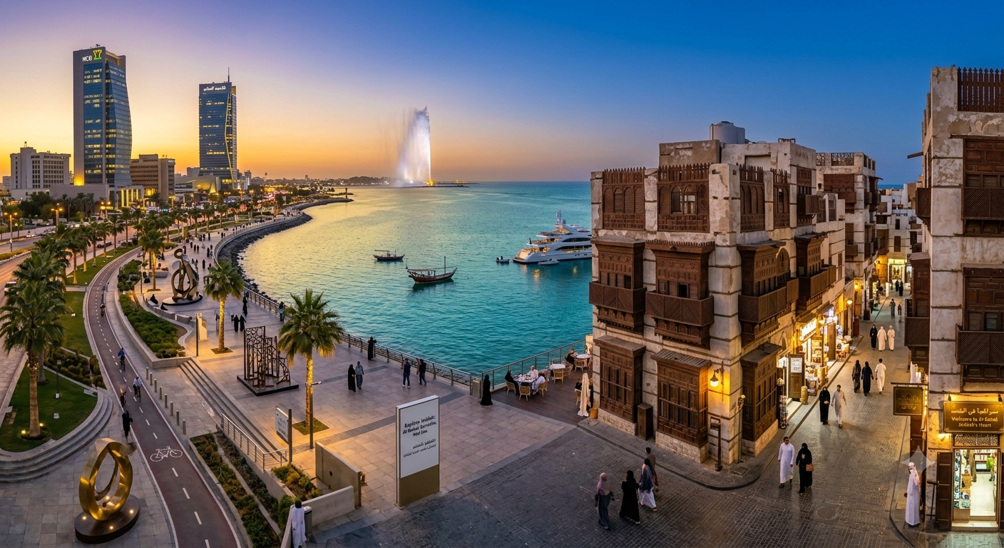
This is the reason to stop. Al-Balad is the historic centre, listed by UNESCO in 2014 as Historic Jeddah, the Gate to Makkah. Its houses were built from coral stone quarried out of the Red Sea, several storeys high, and fronted with carved wooden bay windows called roshan. The lattice screens let the sea breeze through while keeping the sun and prying eyes out. Walking through it is like walking through a much older Arabian port city, because that is what it is. Narrow lanes, tall leaning houses, small shops. The best-known building is Beit Nassif, the Nassif House, a large merchant’s home with a famous tree outside it for years, the only tree in the district. King Abdulaziz stayed there. It is open to visitors and worth going inside for the courtyard and staircase alone.
Souq Al Alawi runs through the middle of the district. It sells everything, and it is at its best in the evening. One honest note: Al-Balad is in the middle of a long restoration programme. Some buildings are beautifully restored, others are behind scaffolding, and a few are propped up and closed off. It is a working conservation site rather than a finished attraction. Most people find that adds to it rather than detracting. Go in the late afternoon. The lanes are shaded, the heat drops, and the district comes alive after Maghrib.
The Corniche
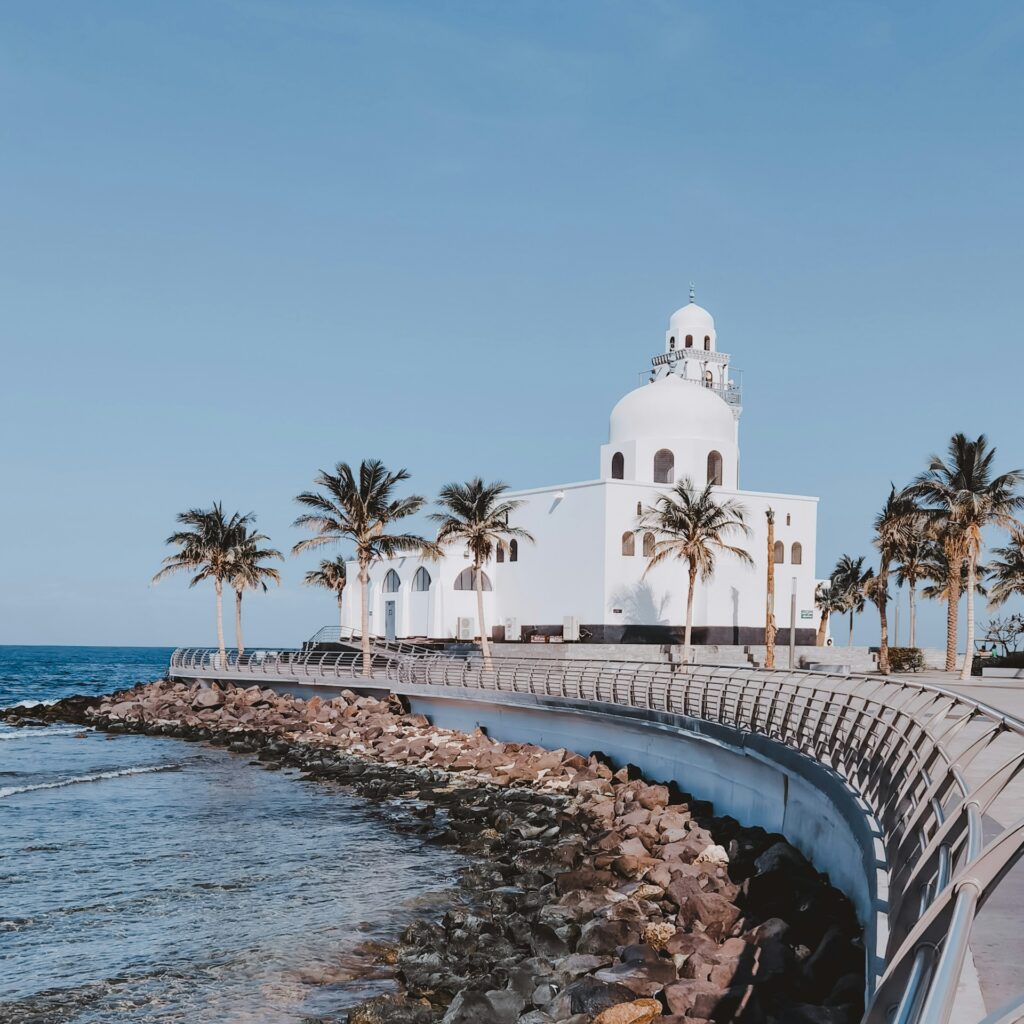
Jeddah’s waterfront runs for roughly 30 kilometres along the Red Sea, and it is where the city goes to relax. It has been extensively redeveloped over the past few years, with paths, parks, cafés, play areas, and a large collection of open-air sculptures. Families gather in the evenings, people fish off the rocks, and it stays busy late. The landmark is the King Fahd Fountain, which pumps seawater to a height of around 260 metres and is the tallest fountain in the world. It runs in the evenings and is visible across much of the city. Further along is Al-Rahma Mosque, usually called the Floating Mosque, built out over the water on supports so that it appears to sit on the sea at high tide. It is a genuinely beautiful building and a popular place to pray at sunset.
The Red Sea
The Red Sea reef starts remarkably close to the shore here. Diving and snorkelling around Jeddah is very good, with healthy coral and clear water. The main dive operations run out of Obhur, a creek north of the city, and most will collect you from your hotel. Water temperatures are comfortable year-round. Visibility is generally best in spring and autumn. If you are travelling with children and want a beach day, the resorts along the coast north of the city are the easiest option.
Food
Jeddah is the best city in Saudi Arabia to eat in, and it is not close. Seafood is the obvious strength, straight off the boats and usually grilled simply. For breakfast, look for foul — slow-cooked broad beans — with fresh tamees bread from a clay oven. It costs almost nothing, and it is very good. Beyond that you will find strong Yemeni, Egyptian, Levantine, Indian and Pakistani cooking, reflecting who settled here. Ask your driver where he eats rather than looking for a restaurant with an English menu.
Getting there from the UK
Jeddah’s King Abdulaziz International Airport handles most UK pilgrim traffic, and there is a dedicated Hajj and Umrah terminal. Direct flights run from London, and the number of UK routes to Saudi Arabia has grown over the past year with Riyadh Air entering the market alongside Saudia and British Airways. For travellers outside the capital, the practical question is usually whether to fly direct from a regional airport or connect through London or the Gulf. We cover the options for each city on our Umrah Packages from London, pages. Flight time from the UK is around six hours direct.
Getting to Makkah and Madinah
This is where Jeddah’s position becomes useful. The Haramain high-speed railway connects Jeddah to Makkah in about half an hour, and to Madinah in roughly two hours. It is comfortable, punctual and far more pleasant than the coach. By road, Makkah is around an hour from Jeddah depending on traffic, which can be heavy in peak season. Practically, this means you can land in Jeddah, spend an afternoon and evening in Al-Balad, sleep, and be in Makkah before lunch the next day without losing any real time from your pilgrimage. If you would rather not deal with driving or changing between different forms of transport, a private transfer can make the journey more straightforward. Door-to-door service is particularly useful when travelling with luggage or children, and having a local English-speaking driver means you can get practical help along the way
When to go and how long to stay
Jeddah is milder than inland Saudi Arabia but more humid. Winter, from November to March, is comfortable at around 19–29°C. Summer is hot and sticky rather than dry-hot. One full day covers Al-Balad and the Corniche. Two days let you add a dive trip or a slower morning by the sea. If you are visiting in the winter months, check whether Jeddah Season is running — the city hosts a programme of concerts, markets and events through part of the year, and it changes the atmosphere considerably.
Fitting Jeddah into an Umrah trip
The simplest approach is to build a day in at the start. Land in Jeddah, stay the first night there rather than transferring straight to Makkah, and see Al-Balad in the afternoon. You arrive in Makkah rested rather than off a long flight, which matters more than people expect when you are about to perform tawaf. The alternative is to keep the day for the end, after Madinah, before flying home. That works too, though most people prefer to finish in Madinah. Either can be built into our Umrah packages; it is a common request, and it usually adds very little to the cost, because you are already flying into the city.
Frequently asked questions
Is Jeddah worth visiting?
Yes, particularly if you are already flying through it for Umrah. Al-Balad old town and the Corniche can both be seen in a single day, and Jeddah is the most relaxed city in Saudi Arabia.
How far is Jeddah from Makkah?
About an hour by road, or roughly 30 minutes on the Haramain high-speed train. Madinah is around two hours by train.
Can non-Muslims visit Jeddah?
Yes. Jeddah is open to all visitors on a Saudi tourist visa. Only Makkah and central Madinah are restricted to Muslims.
What is Al-Balad known for?
Al-Balad is Jeddah’s historic centre, listed by UNESCO in 2014. It is known for tall coral-stone houses with carved wooden roshan balconies, traditional souqs, and buildings such as Beit Nassif.
How many days do you need in Jeddah?
One full day covers the main sights. Two days allow for a diving or beach trip on the Red Sea alongside the old town and Corniche.
Is Jeddah hot?
Yes, and humid. Summer is uncomfortable, with high temperatures and high humidity. Winter is pleasant, around 19–29°C, and is the best time to visit.
Follow the rest of the Top Experiences series
- TOP TWENTY THINGS TO DO IN EGYPT
- WHY YOU SHOULD VISIT MALTA
- TOP FUN THINGS TO DO IN HAMPI
- 10 HISTORICAL PLACES TO ROAM ACROSS THE WORLD
- 10 HISTORICAL MARVELS OF ITALY
- 10 BEST SHOWS IN EUROPE YOU MUST SEE
- DUBAI THRILLS: 7 MUST-DO ACTIVITIES
- 10 HISTORICAL MARVELS IN TURKEY TO ENJOY WITH KIDS
- MOST ENCHANTING PALACES IN EUROPE
- IN‑BETWEEN MOMENTS IN ASPEN
RESPONSIBLE TRAVELING-BECAUSE I CARE