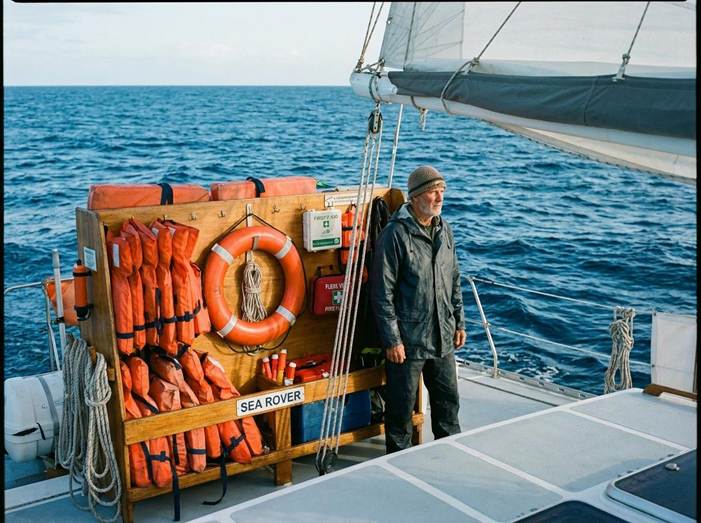
Essential safety gear every open-water traveler needs before casting off
Water-based adventures are booming. Whether it’s a three-day catamaran charter in the Maldives, an island-hopping sailing trip through the Aegean, or a snorkeling boat out of Hurghada, more travelers than ever are spending meaningful time far from shore. According to Future Market Insights (2025), the global water adventure tourism market is projected to grow from USD 0.3 trillion in 2025 to USD 0.8 trillion by 2035, at a compound annual growth rate of 12.3%.
Most of those travelers pack carefully. They research their destination, book the right accommodation, and think hard about what shoes to bring. Very few think about what happens if the boat they’re on gets into serious trouble. That gap – between the care we put into travel planning and the near-zero thought we give to maritime safety – is worth closing before your next ocean excursion. The good news is that fixing it doesn’t require sailing qualifications. It just requires knowing what questions to ask and what gear to look for.
Why open-water travel demands a different kind of preparation
On land, if something goes wrong, help is rarely more than a few minutes away. At sea, it can be hours or days. That’s not a scare tactic. It’s a basic feature of the environment that changes the calculus of risk.
The numbers from the U.S. Coast Guard make the case plainly. In 2024, the USCG recorded 3,887 boating incidents resulting in 556 deaths, 2,170 injuries, and roughly $88 million in property damage – and that was actually the lowest fatality count in more than 50 years. Of boating drowning deaths where the cause was known, 87% of victims were not wearing a life jacket. Drowning accounts for 76% of all boating fatalities. These aren’t freak occurrences. They’re consistent patterns, year after year.
What’s striking is how many of these incidents involve recreational travelers rather than professional mariners. The Mediterranean, the Red Sea, and the South Pacific are all dotted with charter boats carrying tourists who’ve never received a safety briefing. Someone who puts real effort into sailing the Greek islands will typically research the best anchorages, the local cuisine, and the ideal sailing season – but won’t necessarily know what equipment the boat carries or what to do in an emergency. The solution isn’t to avoid these trips. It’s to stop treating them as city breaks and start treating them as the offshore adventures they are.
The life raft: your last line of defense
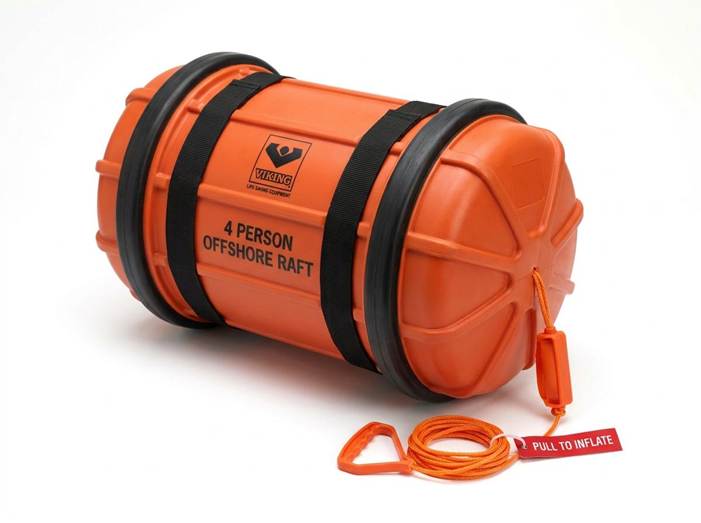
Modern compact life rafts are designed for quick deployment in emergencies at sea.
If a vessel sinks, catches fire, or becomes uninhabitable offshore, the life raft is what keeps people alive. It’s not a precaution in the same category as sunscreen. For anyone boarding a boat that will travel more than a few miles from shore, a Switlik life raft aboard the vessel is the single piece of equipment you hope you’ll never need – and the only reason some people make it home when things go wrong.
A life raft is not just a rubber ring. A proper offshore-grade raft is a survival system: it has a self-erecting canopy for weather protection, an insulated double floor to prevent hypothermia, ballast pockets that stabilize the raft in waves, a boarding ramp for exhausted survivors, and an emergency kit that typically includes water rations, food, flares, a bailer, and seasickness tablets.
There’s an important distinction between coastal and offshore rafts. A boat running day charters close to shore and a vessel on a multi-day blue-water passage need different specifications. Offshore rafts meet SOLAS (Safety of Life at Sea) standards, which dictate minimum contents and construction requirements for survival gear on vessels operating far from land. For travelers booking multi-day sailing trips or ocean crossings, it’s worth asking whether the raft onboard meets those standards.
Before you board, check three things: is there a life raft on board, what is its last service date (life rafts require professional inspection every one to three years), and is it properly mounted in a location where it can actually be deployed in an emergency? The US Sailing Safety Equipment Requirements outline what regulated offshore vessels are required to carry, including life raft specifications that match the vessel’s intended range. Even if you’re chartering rather than competing, these standards are a useful benchmark.
The rest of your safety kit
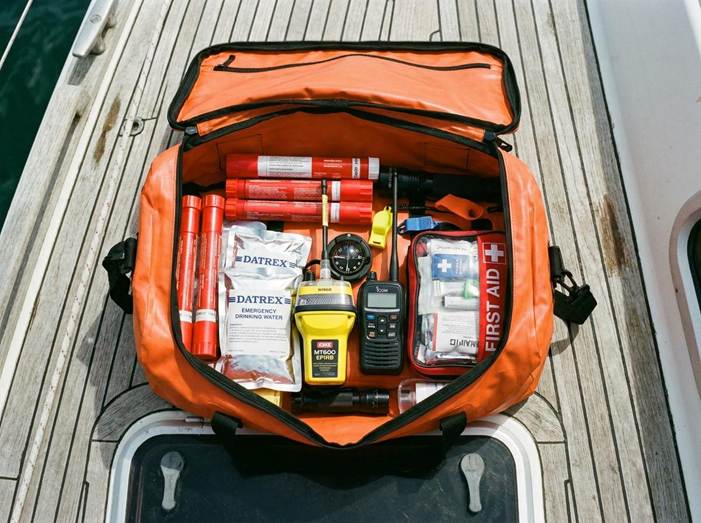
A well-stocked grab bag can mean the difference between survival and disaster when abandoning ship.
A life raft is the last resort. Before you get there, several other pieces of gear determine whether a crisis is manageable or catastrophic. Life jackets are the obvious ones, but the USCG statistic bears repeating: 87% of drowning victims in 2024 weren’t wearing them. A life jacket stowed in a compartment doesn’t do much good. Ask the charter operator whether life jackets are accessible on deck, whether they’re sized correctly for passengers, and whether an automatic inflation type is available for offshore passages.
An EPIRB (Emergency Position-Indicating Radio Beacon) or PLB (Personal Locator Beacon) is what calls for help when you can’t. EPIRBs are vessel-mounted and activate automatically on contact with water; PLBs are personal devices you wear or carry. Either one transmits a distress signal to the international COSPAS-SARSAT satellite system, which alerts maritime rescue coordination centers with your GPS position. Cell phones don’t work offshore. These do.
A VHF marine radio is how you communicate with other vessels and the coast guard when you’re at sea. Channel 16 is the international distress and calling frequency. Any reputable charter boat should have one, and knowing how to use it takes about 10 minutes to learn. Flares remain essential even with modern electronics. Visual distress signals are often what a passing vessel sees before they hear anything. A grab bag – sometimes called a ditch bag – should hold flares, a handheld VHF, copies of key documents, water, and anything else the crew would want in the 30 seconds between “we need to abandon ship” and “the boat is gone.”
Travelers who book a Red Sea yacht charter or a similar ocean excursion will often encounter this equipment firsthand – but usually without anyone explaining what it’s for. Asking the crew for a quick walk-through is reasonable, and most operators will appreciate it. The NOAA Ocean Service’s resources for recreational boaters include guidance on charts, navigation tools, and pre-departure planning that applies to anyone spending time on the water, whether you’re the skipper or a paying passenger.
What to ask before you board any charter or tour boat
There’s a category of traveler who books a boat trip the same way they book a restaurant – they show up, sit down, and trust the professionals to handle everything. That’s fine for dinner. Offshore, it leaves you entirely dependent on the preparation of people you’ve never met. Asking a few direct questions before departure costs you nothing. Reputable operators expect it.
Ask whether there will be a safety briefing before the boat leaves the dock. A competent charter company gives one. If the crew seems annoyed by the question, that’s information. Ask to see the life jackets and confirm they’re accessible. Ask about the life raft – is there one, and when was it last serviced? Ask whether the vessel has a working VHF radio and EPIRB. Ask what the procedure is if someone goes overboard.
The reason these questions matter isn’t just theoretical. According to the U.S. Coast Guard’s 2024 Recreational Boating Statistics, 69% of boating fatalities that year occurred on boats where the operator had received no formal safety instruction. Only 19% of fatalities occurred on vessels with a trained, certified operator. The operator’s background is a real factor in your safety.
Good travelers think about this the same way they think about everything else they pack. The habit of packing for the unexpected – carrying what you might need rather than just what you plan to use – translates directly to on-water safety. You don’t expect to need the emergency kit. You make sure it’s there anyway.
Sail boldly, prepare wisely
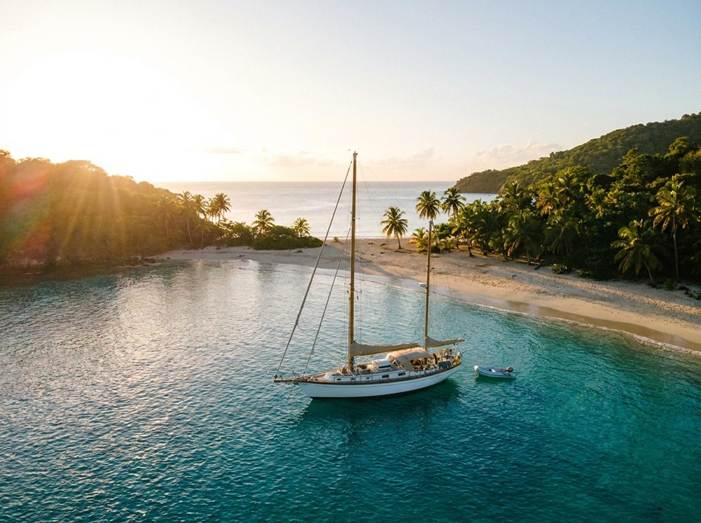
With the right safety gear on board, open-water adventures can be as memorable as they are safe.
The world’s best travel memories often happen on water. Watching a Greek island appear over the bow at sunrise, snorkeling a coral reef in the Maldives, anchoring in a quiet bay that nobody else seems to know about – these experiences don’t happen on the couch. They require getting on a boat and going somewhere. Safety gear doesn’t take anything away from that. It’s what makes it possible to do it again.
Before your next offshore adventure, run a simple check: is there a life raft, are the life jackets accessible and sized correctly, does the vessel have distress signaling equipment, and will the crew brief you on what to do in an emergency? If the answer to those questions is yes, you’re already ahead of most recreational boaters on the water. The adventure is worth it. Go prepared.
Follow the rest of the Top Experiences series
- TOP TWENTY THINGS TO DO IN EGYPT
- WHY YOU SHOULD VISIT MALTA
- TOP FUN THINGS TO DO IN HAMPI
- 10 HISTORICAL PLACES TO ROAM ACROSS THE WORLD
- 10 HISTORICAL MARVELS OF ITALY
- 10 BEST SHOWS IN EUROPE YOU MUST SEE
- DUBAI THRILLS: 7 MUST-DO ACTIVITIES
- 10 HISTORICAL MARVELS IN TURKEY TO ENJOY WITH KIDS
- MOST ENCHANTING PALACES IN EUROPE
RESPONSIBLE TRAVELING-BECAUSE I CARE