
How Technological Innovation Creates New Career Opportunities
The nature of work and the skills required to succeed in the workforce are changing. For example, once coveted ‘skills’ of working in an office have become less valued as more and more work has shifted online. Alternatively, as technologies change and impact the workforce, newly created industries raise the demand for additional skills. Although Kuwait is still developing its Information and Communication Technology (ICT) infrastructure, there is the potential for positive change in the country’s labor market. In addition to the large unemployed population, positive changes are also needed to address the country’s youth employment challenge.
Mobile entertainment offers a clear example of how digital services create new employment opportunities. Sports betting platforms rely on more than the apps their customers use. Behind every feature is a team responsible for software development, interface design, cybersecurity, and technical support. In Kuwait, the growing demand for the Melbet app download (Arabic: تنزيل تطبيق Melbet) reflects how mobile entertainment services depend on skilled professionals to develop, maintain, and improve their applications. Experience gained in these roles can also open doors in banking, e-commerce, delivery services, and other industries where mobile technology has become essential.
How Digital Innovation Changes the Job Market
Computers have taken over most mundane tasks. Once upon a time, employees kept customer details in file cabinets, processed payments with ledgers, and scheduled business activities on calendars. Now, businesses buy programs to digitize each of these tasks and more. Like most computer programs, each system requires human users to optimize its potential. As companies become more digitized, the number of specialized users also increases. Sports betting is one example of how the digital economy creates demand for specialized technical skills. Beyond managing betting markets, operators need professionals who can maintain secure payment systems, protect customer information, and make their platforms easy to navigate. Even a routine action like the Melbet login (Arabic:تسجيل الدخول في melbet) depends on authentication technology, account security measures, and reliable software infrastructure. Developing and maintaining these systems requires expertise in programming, cybersecurity, and user experience design. The same skills are valuable in banking, e-commerce, and other digital industries, giving employees opportunities to build careers beyond the betting sector.
Career Paths Created by New Technologies
Positions in the tech sector can range from software development to digital service management to customer service. Actually, many sectors of the economy have been impacted by the tech industry. Manufacturing used to be the largest employment sector, but it has been losing jobs for decades. Recently, employment gains in tech industries have more than made up for losses in manufacturing.
| Industry | New career opportunities | Important skills |
| Finance | Digital banking specialist, fintech developer | Payment systems, financial software |
| Healthcare | Medical technology coordinator | Digital records, healthcare systems |
| Education | Online learning designer | Educational software, digital content |
| Retail | E-commerce manager | Online sales, customer management |
| Energy | Smart equipment technician | Digital monitoring, technical maintenance |
| Entertainment | Application developer, platform manager | Mobile software, user experience |
Kuwait’s Digital Development and Employment Opportunities
According to Kuwait Vision 2035, the Government of Kuwait aspires to diversify its economy and enhance its infrastructure and public services through public-private partnerships. This would stimulate the economy to become more technology-oriented and skilled. Many national businesses have transitioned to electronic means to conduct business and interact with clients. Furthermore, many businesses have integrated electronic payment systems. These and other recently adopted information technologies and systems require the services of skilled and trained personnel. The number of job vacancies across all sectors has been increasing. This presents employment opportunities for nationals to gain work experience.
Financial Technology Creates Specialized Careers
FinTech combines traditional banking with modern software. Customers can perform banking functions like money transfers and balance inquiries via computer programs. Developing and maintaining FinTech systems requires a workforce of programmers, technicians, and support personnel. Programmers build secure systems and integrate financial systems. Support personnel help clients with digital transactions. Kuwait offers many openings for financially savvy and technically skilled people. Career advancement for banking personnel is available in payment and financial data systems.
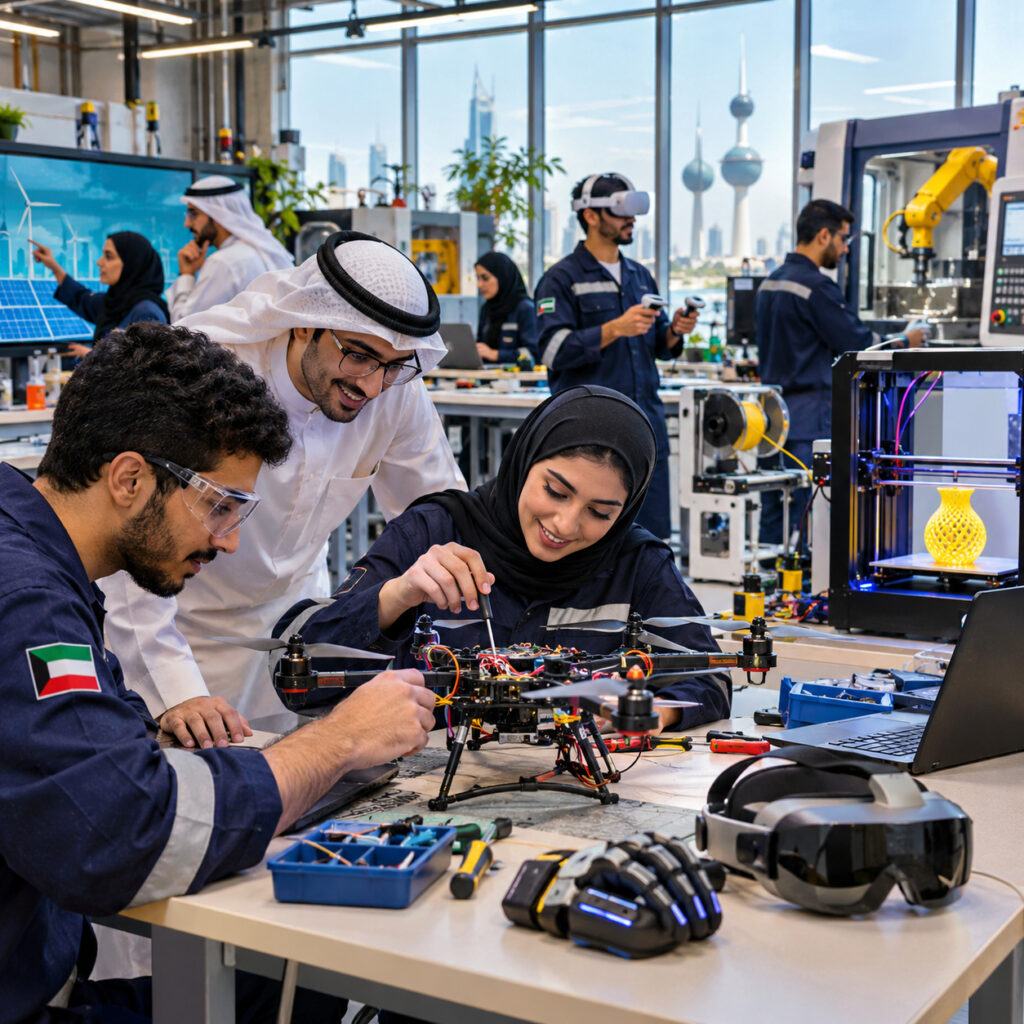
Skills That Support Careers in Technology
Knowledge of digital technologies is essential for participating in the global economy. Although advanced programming skills are rare outside the tech sector, familiarity with various digital technologies and some basic programming skills can be useful.
Relevant skills include:
- Comfort with computers and the internet.
- The ability to create web pages and programs to increase business efficiency.
- Evaluating business data and identifying underlying trends.
- Implementing controls to secure business data.
- Utilizing virtual storage and digital applications for business.
Diversifying into related skills can provide greater employment opportunities. For example, skills in data analysis can help one understand customer purchase behavior and trends in online sales.
Why Practical Experience Matters
While courses reflect a candidate’s interest, projects display their ability to work with and apply course concepts. Someone interested in web development can create a business website as a course project, and someone interested in data analysis can create a report as a course project. In addition to showcasing skills to a potential employer, projects help build a portfolio. People interviewing for a position can analyze and explain their work, and describe how they approached and solved problems.
Artificial Intelligence Creates New Responsibilities
Artificial Intelligence affects the way businesses structure their employees and work processes. Companies use various forms of artificial intelligence to analyze documents and assist in customer service. Additionally, the implementation of artificial intelligence in businesses creates new opportunities for careers in data management and software engineering. Businesses are now interested in employing individuals who have an understanding of the automated systems and their effects on business operations.
Combining Industry Experience With Technology
Workers can apply specific industry-related digital skills because of their occupation and/or experience. Teachers can utilize knowledge of educational software to create classroom content. Employees in the healthcare field can assist in the adoption of electronic health records and other digital resources. For both of these scenarios, workers can evaluate and offer feedback regarding the technology and resources created to help them in their daily work activities.
Entrepreneurship and Independent Digital Work
The internet provides opportunities for people to start businesses without traditional physical infrastructure. Online businesses allow employees to work from anywhere and do not require large office spaces to communicate with clients. Kuwaiti nationals can use online resources to create independent contracts with clients beyond Kuwait. For example, someone may provide artistic services to a firm based in a different country, while another person may provide programming services to a small business.
Opportunities for Freelancers and Small Businesses
Digital businesses develop and evolve in various ways. As a result, there are different types of short-term projects available. People who like to work on different projects (i.e., independent workers) may find various opportunities in the digital economy.
Some examples of these opportunities are:
- Web development: Helping businesses by creating or updating their websites.
- Digital marketing: Planning and managing online promotional activities.
- Content development: Producing audio, video, and text content.
- Technology: Advising businesses on which digital solutions to implement.
- Customer service: Assisting customers in using online and digital products.
Many of these projects allow independent workers to build and maintain long-term, positive business relationships. Successful, independent professionals may choose to open new businesses (e.g., a marketing agency) or extend their existing business by offering new services.
Traditional Industries Are Adopting Modern Technology
Digital innovation transforms even the most established industries. Digital innovations in manufacturing allow companies to track and monitor their production in ways never before possible. Advances in logistics and shipping help companies plan and optimize their delivery schedules. As a result, industries can employ machinery technicians and digital system technologists. Often, the more senior workers in a company can prove to be the most helpful in integrating new company equipment. Because of the rapid digital transformation, most companies can afford to employ the senior workers that they might otherwise dismiss.
Education and Training Open New Career Paths
Professional development requires the acquisition of new skills. Education on aspects of technology is readily available at universities, training centers, and online. There are programs for learner-level software development and cybersecurity. More expert-level training in various technologies is available. Ultimately, the field an individual wishes to work in determines the skills they must acquire. An individual planning a career in digital marketing is not expected to have the same skills as someone pursuing cloud engineering.
The Value of Continuous Professional Learning
It’s essential for employees to keep up with industry trends in order to be competitive in the job market. By keeping up with industry trends, employees may learn skills that may prove valuable when seeking employment. Staff may be able to increase their industry knowledge through participation in industry-related seminars and by earning professional certifications. The ability for employees to learn new skills may benefit the employer by increasing the organization’s flexibility and productivity. By developing skills that facilitate the use of new organizational technology, employees may enhance their careers by advancing within the organization.
Follow the rest of the Top Experiences series
- TOP TWENTY THINGS TO DO IN EGYPT
- WHY YOU SHOULD VISIT MALTA
- TOP FUN THINGS TO DO IN HAMPI
- 10 HISTORICAL PLACES TO ROAM ACROSS THE WORLD
- 10 HISTORICAL MARVELS OF ITALY
- 10 BEST SHOWS IN EUROPE YOU MUST SEE
- DUBAI THRILLS: 7 MUST-DO ACTIVITIES
- 10 HISTORICAL MARVELS IN TURKEY TO ENJOY WITH KIDS
- MOST ENCHANTING PALACES IN EUROPE
- IN‑BETWEEN MOMENTS IN ASPEN
RESPONSIBLE TRAVELING-BECAUSE I CARE


